In this article (10)▾
There is a specific kind of tired that sleep does not fix. You go to bed at a reasonable hour. You wake up and nothing in you rises to meet the day. Not sadness exactly. Not illness. Just a flatness where the spark used to be, and a quiet worry that this is simply what you are like now.
It usually shows up after something: a long caregiving stretch, an illness, a grief, a job that took more than it gave. The heavy thing has been put down and you still cannot feel light.
Spearmint flower essence is what I formulate for that season. This guide covers the essence specifically. What it is, why spearmint rather than peppermint, who it fits, how to take it, and what the first month or two actually looks like. If flower essences are new to you, start with Flower Essences 101.
What spearmint flower essence actually is
Spearmint flower essence is made the traditional Bach way: fresh spearmint blossoms (Mentha spicata) floated on mountain water in a glass bowl in direct sun, then preserved in brandy. Brandy and mountain water has been the clinical gold standard for flower essence work since the 1930s, and it is what keeps the finished essence shelf-stable for years without refrigeration. The full account of the method is at the Bach method, explained.
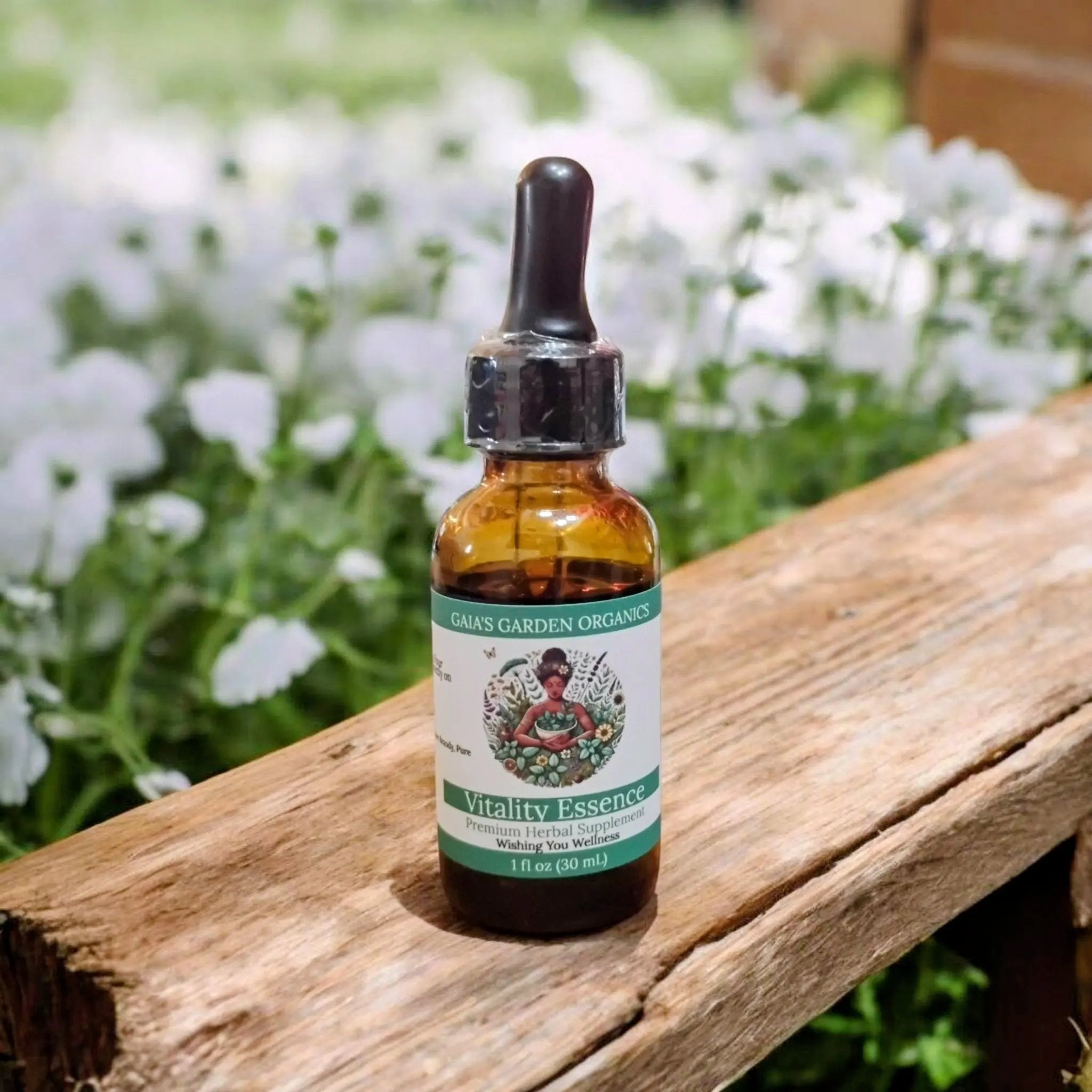
Ours is made from spearmint grown in our medicine garden in Umpire, Arkansas, with spring water from the property. We sell it as Vitality Essence, $36 for a 1 fl oz bottle.
It contains water, brandy, and the sun-infused imprint of the flower. No measurable plant chemistry, no mint smell, no cooling sensation. It works on the emotional layer rather than through the body's chemistry, which is the whole reason it can be described as supporting energy without being a stimulant in any sense.
Spearmint the essence has nothing to do with spearmint the tea
This one needs saying loudly, because our own most-read spearmint article is about something completely different.
Spearmint as a tea or supplement is best known for its hormonal territory, and that is what most of the research and most of the internet is about. We have written about it ourselves in spearmint tea for PCOS, and the plant's chemistry, its traditional uses, and its cautions are in the spearmint monograph.
The flower essence is not doing any of that. It contains no measurable plant chemistry, so it has no anti-androgenic action, no hormonal action, and no effect on hirsutism. If you came here looking for the PCOS use, you want the tea, and you should read that article instead.
What the essence is used for is a single emotional territory: burnout, flatness, and the return of lightness after a heavy season.
Why spearmint and not peppermint
These are cousins and people assume they are interchangeable. In clinic they are not, and the distinction is the most useful thing on this page.
Where peppermint sharpens, spearmint lifts. Peppermint is the plant for the mind that will not come to a point: fog, scatter, unfinished tasks, decision fatigue. That is Clarity Essence. Spearmint is softer and kinder, and its territory is not focus at all. It is the felt sense of aliveness returning to a system that has been running on empty.
The practical version: if you can concentrate perfectly well and simply do not care about anything, you want spearmint. If you care a great deal and cannot hold a thought still, you want peppermint. Sharpening an empty tank tends to just show you, in higher resolution, how empty it is.
The pattern spearmint essence is matched to
The person this fits is very often the one who held everything together for somebody else and has not yet been given permission to stop.
What it tends to look like:
- Sleep is adequate and rest is not restorative. You wake up already tired.
- Things you used to enjoy are still objectively enjoyable and produce nothing in you.
- You are functional. You show up. There is just no color in it.
- The idea of doing something purely for pleasure feels faintly ridiculous.
- You put down a long, heavy chapter, and lightness has not come back on its own.
- People say you seem fine, and you cannot argue, and that is somehow worse.
That third one is the tell. This pattern is rarely dramatic. It is a slow greying-out that the person has usually stopped mentioning, because nothing is technically wrong.
Spearmint's signature, in the way traditional flower essence practitioners read plants, is a soft brightness rather than a jolt. It is the quality of a long winter window finally opening to the first warm air. That is what the essence is used to support: not stimulation, just the body's natural lightness finding its way back.
If the depletion is specifically caretaker depletion, I have written the herbal side of that protocol in herbs for the depleted caregiver.
Who spearmint essence is not for
- If you are wound tight rather than flat, the problem is over-alertness, not depletion. That is lavender. See Tranquility Essence.
- If the problem is fog and scatter, see Clarity Essence, as above.
- If you are in the early months after a loss, the flatness is grief and it should be met as grief, not as a spark problem. See Heartful Essence.
- If you are depleted because you cannot say no, the essence will not fix the inflow. Start with Confidence Essence and the boundary work.
- If your fatigue is physical in origin, thyroid, anemia, sleep apnea, medication effects, nutritional deficiency, or post-viral illness, please get bloodwork and a clinician. Persistent unexplained fatigue deserves a real workup. An essence can sit alongside that; it cannot substitute for it, and I would rather say so plainly than sell you a bottle.
- If the flatness comes with hopelessness or thoughts of self-harm, that is depression and it needs professional care now, not a four-week essence trial.
Not sure which is yours? The Spark-Type Quiz is free.
How to take Vitality Essence
- Standard daily dose. Four drops in the morning, and again in the early afternoon if the slump arrives. Under the tongue, in a glass of water, on the pulse points of the wrist, or on food.
- Loading dose for the first three days. Four drops, two to three times per day for the first 72 hours.
- Repetition. Drops can be repeated as needed. There is no overdose risk; essences work on the emotional body, not pharmacologically.
- Combining. Up to three essences at once, dropped into the same glass of water and sipped through the day.
The timing note for this one is different from the others. Take the morning dose before you decide what kind of day it is going to be. People in this pattern tend to assess their energy the moment they wake, conclude there is none, and set the day accordingly. The dose belongs before that verdict.
A 1 fl oz bottle holds roughly 600 drops, which is four to five months of consistent daily use.
What to expect, and when
Set your expectations low and specific. This is the slowest of the five in my experience, and it should be.
- Week 1. Usually nothing you would call energy. What people report first is a small willingness: opening a window, putting music on, going outside without a reason.
- Weeks 2 to 4. Interest comes back before energy does, and it comes back in odd small places. Someone notices they wanted a particular meal. Someone reads two pages of a book for pleasure. Do not dismiss these as trivial; they are the actual signal.
- Weeks 4 to 8. The mornings change. The gap between waking and being able to meet the day gets shorter.
- Months 2 to 6. Lightness stops being an event and goes back to being a baseline. This is a long repair and it moves at the pace of a long repair.
The mistake I see most is treating week two as a verdict. This pattern took months or years to build and it does not unwind in ten days. The general onset arc for all five essences is at how long flower essences take to work.
The practice I pair it with
In Yoga Therapy, the anchor for a depleted system is not effort. Adding a demanding practice to an empty person is how burnout gets deeper. The anchor is Sun (Surya, SOOR-yah), which in practice means one deliberate contact with morning light, and Pulsation (Spanda, SPAHN-dah), the tradition's word for the subtle vibration of aliveness that is present even when you cannot feel it.
The practice takes about three minutes:
- Take the drops first thing, before your phone.
- Go outside, or to a window, within the first hour of waking. Face the light with your eyes closed.
- Stand there for 60 seconds. Do not try to feel grateful or energized. Just receive the light on your face.
- Then, for another 60 seconds, notice one thing that is alive. A bird, a plant, your own pulse. One is enough.
That last step is the whole practice, and it is deliberately tiny. The depleted pattern cannot be argued into aliveness, but it can be repeatedly shown a small piece of it. Patanjali calls that steady repetition over time Abhyasa (ah-BHYAH-sah). Sixty seconds daily beats an ambitious routine you abandon in week two.
Alcohol, pregnancy, children, and dogs
- Alcohol. Brandy is the preservative, and the amount in a four-drop dose is very small. If you avoid alcohol entirely, drop the dose into warm water and let it sit two minutes before taking it.
- Pregnancy and nursing. Flower essences are considered low-risk and non-reactive, because they work on the emotional body rather than through biochemistry. The brandy carrier is the only caveat. Tell your healthcare provider what you are taking.
- Hormone-sensitive conditions. Spearmint as a tea or supplement has mild measurable anti-androgenic activity, and our monograph asks anyone with a hormone-sensitive condition to discuss daily spearmint tea with their oncologist or endocrinologist. That caution belongs to the plant's chemistry. A finished essence contains no measurable plant chemistry, so that caution belongs to spearmint tea and supplements rather than to Vitality Essence.
- Medications. Considered non-reactive with conventional medications. Tell your provider anyway.
- Children. One to two drops diluted in water, juice, or tea, one to two times a day.
- Dogs and cats. Two to four drops in the water bowl, on food, or on pulse points such as inside the ears or the paw pads. Avoid dosing small pets directly in the mouth. This is a common choice for rescue animals settling into a new home. Talk to your veterinarian about ongoing concerns.
Where to go from here
- Step 1 (free). Take the Spark-Type Quiz and I will match you to the essence for your actual pattern.
- Step 2 (30-night guarantee). Vitality Essence, four drops each morning, for a minimum of six weeks given how slow this arc is. Bach method, brandy and mountain water, made in our garden and covered by the 30-night guarantee.
- Step 3. Harmony Within, my Yoga Nidra book, for the deep-rest work that a depleted system actually needs.
Flower essences are traditional emotional support and are not a substitute for medical care. Persistent unexplained fatigue should be evaluated by a clinician, and low mood with hopelessness needs professional support.
Frequently asked
What is spearmint flower essence used for?
For burnout, flatness, and the return of lightness after a heavy season. It is matched to the person who put down a long, exhausting chapter and still cannot feel light: sleep is adequate but rest is not restorative, things you used to enjoy produce nothing, and you are functional but there is no color in it. It supports the felt sense of aliveness coming back rather than adding stimulation.
What is the difference between spearmint and peppermint flower essence?
Where peppermint sharpens, spearmint lifts. Peppermint is for the mind that will not come to a point, meaning fog, scatter, and decision fatigue. Spearmint's territory is not focus at all; it is depletion and the return of lightness. The practical test: if you can concentrate perfectly well and simply do not care about anything, you want spearmint. If you care a great deal and cannot hold a thought still, you want peppermint.
Does spearmint flower essence help with PCOS or hirsutism?
No. Spearmint as a tea or supplement is well known for hormonal territory, and that is what most of the research is about, but a finished flower essence contains no measurable plant chemistry, so it has no anti-androgenic action and no effect on hirsutism. If you came for the PCOS use, you want the tea. The essence is used for one emotional territory only: burnout and renewed lightness.
How long does spearmint flower essence take to work?
This is the slowest of the five and it should be. Week one rarely produces anything you would call energy; what people report first is a small willingness, like opening a window or going outside without a reason. Interest tends to come back before energy does, in odd small places, over weeks two to four. Mornings change over weeks four to eight. Full return of baseline lightness runs months two to six. Treating week two as a verdict is the most common mistake.
When is fatigue a reason to see a doctor instead?
If it is physical in origin. Thyroid problems, anemia, sleep apnea, medication effects, nutritional deficiency, and post-viral illness all present this way, and persistent unexplained fatigue deserves bloodwork and a clinician. An essence can sit alongside that work but cannot substitute for it. If the flatness comes with hopelessness or thoughts of self-harm, that needs professional care now, not a four-week essence trial.
Products from this article
Handcrafted in Umpire, Arkansas by Gaia Devi, clinical herbalist.
Explore our apothecary
Learn more
Flower Essences 101
A clinical herbalist's plain-English guide to what flower essences are and how to take them.
Find your match
The Vitality-Type Quiz
5-question clinical-herbalist diagnostic for the depleted caretaker. Matches a daily spark practice + plant pairing.
Shop the apothecary
The 5-Essence Starter Cabinet
All 5 essences bundled at 20% off, the full emotional toolkit.
Sources & further reading
Authoritative references consulted in writing this article. Open in a new tab.
- The Bach CentreHistory of the Bach Flower Remedies
- Chestnut School of Herbal MedicineFlowering Herbs (article archive)
- NCCIHDietary and Herbal Supplements