In this article (9)▾
You open the laptop to do one thing. Ninety minutes later you have touched eleven things, finished none of them, and you could not honestly tell someone what you did with the time. You are not tired exactly. You are not stupid. The thinking just will not come to a point.
Most people reach for more coffee here, and by 3pm the coffee has stopped working too.
Peppermint flower essence is what I reach for with that pattern. Not because it is a stimulant, because it is not one, but because the problem usually is not a shortage of energy. It is a shortage of a single place to put it.
This guide covers the essence specifically. What it is, how it differs from the peppermint you already know, who it fits, how to take it, and what the first month looks like. For the basics of flower essences generally, start with Flower Essences 101.
What peppermint flower essence actually is
Peppermint flower essence is prepared the traditional Bach way: fresh peppermint blossoms (Mentha × piperita) floated on mountain water in a glass bowl, in direct sun, then preserved in brandy. Brandy and mountain water is the clinical gold standard for flower essence preparation and has been since the 1930s. It is what makes the finished essence shelf-stable for years without refrigeration. The full account of the method is at the Bach method, explained.
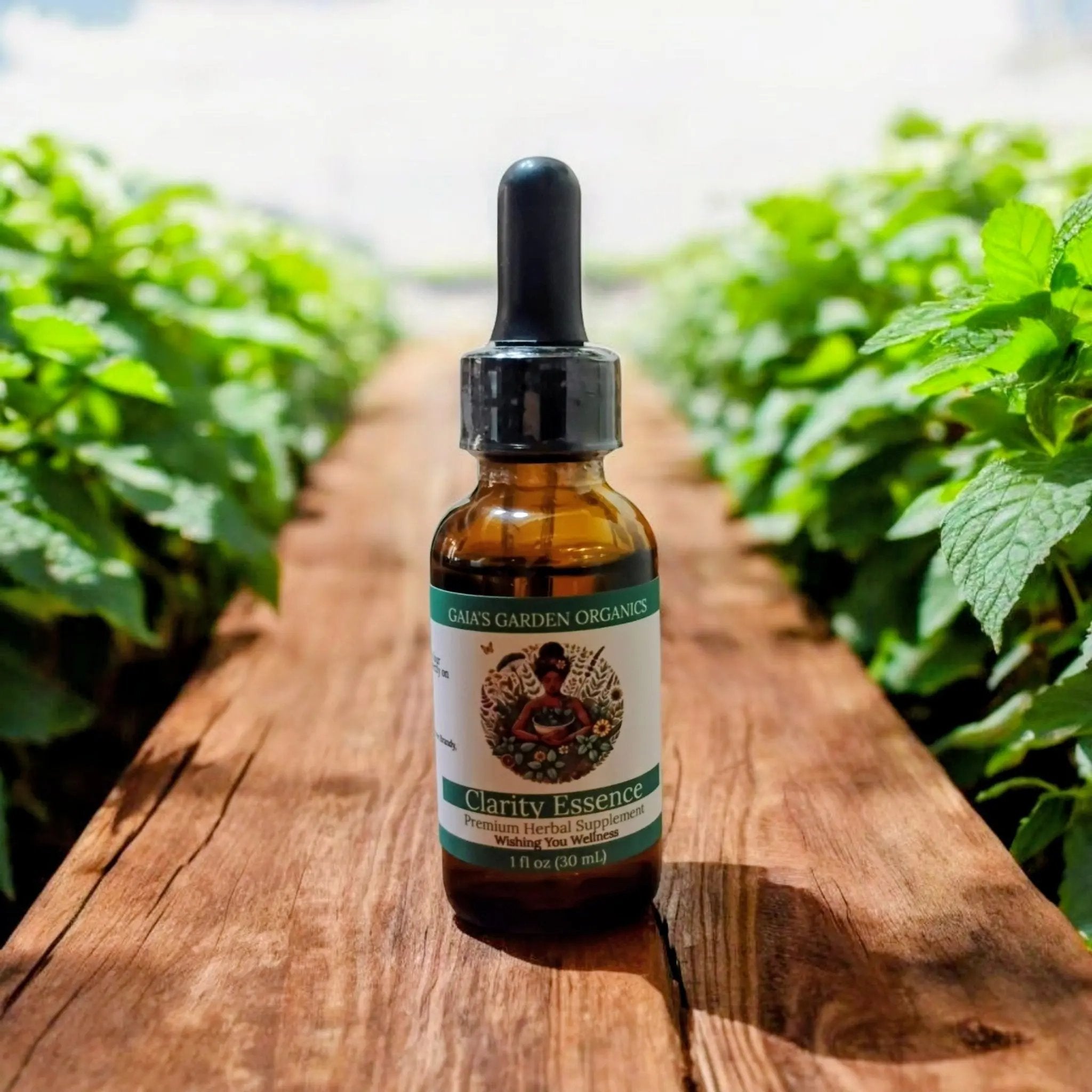
Ours is made from peppermint grown in our medicine garden in Umpire, Arkansas, with spring water from the property. We sell it as Clarity Essence, $36 for a 1 fl oz bottle.
Here is the part that catches everyone: it does not smell like peppermint. It does not taste like peppermint. There is no measurable plant chemistry in a finished flower essence, and no cooling menthol sensation. It smells faintly of brandy and that is all.
If you were expecting the bracing hit you get from peppermint oil, this will feel like nothing at first. That expectation is the single biggest reason people conclude a flower essence "did not work," so let us take it apart properly.
Peppermint essence is not peppermint oil, and the difference matters here more than usual
Peppermint is the plant where this confusion does the most damage, because peppermint essential oil has a genuine and well-known reputation for alertness. People sniff it before exams. It is in every focus blend on the shelf.
That is a different medicine.
- Peppermint essential oil is steam-distilled, intensely aromatic, and concentrated. It works through smell and through the skin, and its effect is immediate, physical, and short. It is generally diffused or diluted, not swallowed.
- Peppermint tea or tincture contains measurable plant compounds and acts on the body's chemistry. The peppermint monograph covers that side of the plant, its constituents, its traditional uses, and its cautions.
- Peppermint flower essence contains no measurable plant matter, has no aroma, and works on the emotional and mental pattern rather than on tissue. Its effect is slower, quieter, and cumulative.
A useful way to hold it: the oil is a jolt, the essence is a habit. If you want to feel something in ninety seconds, use the oil. If you want the scattered pattern itself to loosen over a month, that is the essence's job. They are not competitors. I use both.
Our full side-by-side is at flower essences vs essential oils.
The pattern peppermint essence is matched to
The people this fits are almost never people with a thinking problem. They are people with too many open loops and no protected place to close one.
What it tends to look like:
- You start tasks well and finish them badly, or not at all.
- Your attention gets snagged by every notification, and by the memory of notifications.
- Words go missing mid-sentence, especially names and nouns.
- You reread the same paragraph three times and retain none of it.
- Decisions that should take a minute take a day, and small ones are the worst.
- Caffeine now makes you jittery and scattered rather than sharp.
- By late afternoon there is a dull, cottony quality behind the eyes.
The last two are the tell. When stimulants stop producing focus and start producing agitation, the bottleneck is not fuel. Adding more fuel to a system with no steering makes the scatter worse, which is exactly what the 3pm coffee is doing.
Peppermint's signature in traditional flower essence reading is penetrating clarity, the quality of a mind that comes to a point. That is what the essence is used to support: not more mental energy, but a mind that can settle on one thing.
If the fog is the dominant symptom and you want the herbal side of the protocol as well, I have written that up in the 3pm fog the coffee stopped fixing.
Who peppermint essence is not for
- If you are wound tight and racing rather than foggy, more clarity is not the medicine. That is lavender. See Tranquility Essence.
- If the fog sits on top of real depletion, the post-burnout kind where nothing has any spark, start with spearmint. See Vitality Essence. Clarity into an empty tank tends to just show you more clearly how empty it is.
- If you are grieving, the fog of grief is not a focus problem and should not be treated as one. See Heartful Essence.
- If the scatter is really overcommitment, too many yeses rather than too little focus, the boundary work comes first. See Confidence Essence.
- If cognitive changes are new, rapid, or worsening, please see a clinician. Sudden word-finding trouble, memory loss, or confusion needs a medical workup, not an essence. This matters and I will not soften it.
Not sure which is yours? The Clarity-Type Quiz is free.
How to take Clarity Essence
- Standard daily dose. Four drops, one to two times per day. Under the tongue, in a glass of water, on the pulse points of the wrist, or on food.
- Loading dose for the first three days. Four drops, two to three times per day for the first 72 hours.
- Acute moments. Drops can be repeated every 10 to 15 minutes. There is no overdose risk; essences work on the emotional body, not pharmacologically.
- Combining. Up to three essences at once, dropped into the same glass of water and sipped through the day.
The timing note that matters most for this one: take it before the work block, not during the scatter. Once you are already twelve tabs deep, the dose becomes one more thing you did instead of working. Front-load it. Morning dose before the first task, second dose in the early afternoon before the slump rather than during it.
A 1 fl oz bottle holds roughly 600 drops, which is four to five months of steady daily use.
What to expect, and when
- First dose to day 3. Subtle if anything. Acute shifts with essences are often felt within 15 to 20 minutes, but with this one it usually reads as a slight settling rather than a lift. Do not go looking for a caffeine feeling; you will not find one.
- Week 1. The common first report is finishing one thing. Not feeling sharper, just getting to the end of a single task without leaving it. Watch completion, not clarity.
- Weeks 2 to 4. The gap between distraction and returning gets shorter. You still get pulled away; you come back faster. Chronic-pattern work with essences generally shows up in this window.
- Weeks 4 to 8. Decisions get cheaper. The small ones stop costing a whole afternoon, which is usually where people notice the change has held.
Keep a one-line note each evening about what you finished. This pattern is bad at self-assessment by design, and memory will tell you nothing changed when the notes say otherwise. The general onset arc across all five essences is at how long flower essences take to work.
The practice I pair it with
The Yoga Therapy anchor here is Single-Pointed Focus (Dharana, DHAH-rah-nah), the sixth of Patanjali's eight limbs. Dharana simply means holding attention on one object.
Do not start with meditation. Start with 60 seconds:
- Take the drops. Put the phone in another room.
- Pick one object in your field of view. A cup. A leaf. A door handle.
- Look at it for 60 seconds. Silently name what you actually see: the chip in the rim, the way the light sits on it.
- When the mind leaves, and it will, bring it back without commentary. The returning is the repetition. That is the whole exercise.
Do this once before your first work block. Attention is trainable in the same way a muscle is, and 60 seconds daily beats twenty minutes on a Sunday. Patanjali calls that steady repetition Abhyasa (ah-BHYAH-sah), practice done consistently over a long time.
Alcohol, pregnancy, children, and dogs
- Alcohol. Brandy is the preservative and the amount in a four-drop dose is very small. If you avoid alcohol entirely, drop the dose into warm water and let it sit two minutes first.
- Pregnancy and nursing. Flower essences are considered low-risk and non-reactive, because they work on the emotional body rather than through biochemistry. The brandy carrier is the only caveat. Tell your healthcare provider.
- Reflux, hiatal hernia, and gallstones. This is the one worth reading twice. Peppermint as a tea, oil, or tincture is generally avoided by people with acid reflux or hiatal hernia, because peppermint relaxes the lower esophageal sphincter, and it carries a caution around gallstones. Those cautions come from the plant's chemistry. A finished flower essence contains no measurable plant chemistry, so those cautions belong to peppermint tea, oil, and tincture rather than to Clarity Essence. The herb-form cautions are in full in the peppermint monograph.
- Medications. Considered non-reactive with conventional medications. Tell your provider anyway.
- Children. One to two drops diluted in water, juice, or tea, one to two times a day.
- Dogs and cats. Two to four drops in the water bowl, on food, or on pulse points such as inside the ears or the paw pads. Avoid dosing small pets directly in the mouth. Talk to your veterinarian about ongoing concerns.
Where to go from here
- Step 1 (free). Take the Clarity-Type Quiz and I will match you to the essence for your actual pattern.
- Step 2 (30-night guarantee). Clarity Essence, four drops before your work blocks, for a minimum of four weeks. Bach method, brandy and mountain water, made in our garden and covered by the 30-night guarantee.
- Step 3. Harmony Within, my Yoga Nidra book, for the deeper attention work the essence is supporting.
Flower essences are traditional emotional support and are not a substitute for medical care. New, rapid, or worsening cognitive symptoms should be evaluated by a clinician.
Frequently asked
What is peppermint flower essence used for?
For the mind that will not come to a point. It is matched to scattered focus, unfinished tasks, decision fatigue, rereading the same paragraph, and the dull cottony quality behind the eyes in the late afternoon. The clearest tell is when caffeine has stopped producing focus and started producing agitation, which means the bottleneck is not fuel. It supports the felt sense of mental room rather than adding stimulation.
Is peppermint flower essence a stimulant like caffeine?
No. It is non-pharmacological and non-stimulating. Peppermint essence works at the emotional layer, not the chemical layer, so there is no jitter, no spike, and no crash, and it is appropriate for sensitive systems. If you are expecting the bracing hit you get from peppermint essential oil, you will not find it here. The oil is a jolt; the essence is a habit that compounds over weeks.
Peppermint tea or Clarity Essence for focus?
Different mechanisms, both useful, often used together. Peppermint tea works through aromatic and circulatory chemistry as a mild physiological stimulant. The flower essence works on the emotional layer around mental fog and scattered focus. Many people use both: the tea as needed during the workday, the essence as a steady daily practice.
When should I take Clarity Essence during the day?
Before the work block, not during the scatter. Once you are already twelve tabs deep, the dose becomes one more thing you did instead of working. Take four drops in the morning before your first task, and again in the early afternoon before the slump arrives rather than in the middle of it. For the first 72 hours, four drops two to three times daily helps it settle in.
When is brain fog a reason to see a doctor instead?
If cognitive changes are new, rapid, or getting worse. Sudden word-finding trouble, memory loss, or confusion needs a medical workup, not an essence. Fog that sits on top of real depletion is also a different problem, and clarity into an empty tank tends to just show you more clearly how empty it is; in that case the burnout comes first. A flower essence is daily support, not a substitute for clinical assessment.
Products from this article
Handcrafted in Umpire, Arkansas by Gaia Devi, clinical herbalist.
Explore our apothecary
Learn more
Flower Essences 101
A clinical herbalist's plain-English guide to what flower essences are and how to take them.
Find your match
The Clarity-Type Quiz
5-question clinical-herbalist diagnostic for the overstimulated knowledge worker. Matches a focus practice + plant pairing to your fog pattern.
Shop the apothecary
The 5-Essence Starter Cabinet
All 5 essences bundled at 20% off, the full emotional toolkit.
Sources & further reading
Authoritative references consulted in writing this article. Open in a new tab.
- The Bach CentreHistory of the Bach Flower Remedies
- The Bach CentreWhat are the sun and boiling methods?
- NCCIHDietary and Herbal Supplements