In this article (8)▾
Goldenrod is the plant most people have walked past ten thousand times and blamed for something it did not do. It lines the roadsides here in Umpire in late summer, tall and gold and impossible to miss, and every year somebody points at it and says that is what is making them sneeze.
It is also, in flower essence work, the plant for one of the most common patterns I see in clinic: the person who disappears in a group.
This guide is about goldenrod flower essence specifically. Not goldenrod the tea, not goldenrod the tincture, not goldenrod the roadside weed with the bad reputation. What the essence is, who it is genuinely matched to, how to take it, and what the first two months actually feel like.
If flower essences are new to you, our pillar guide Flower Essences 101 covers the method and the history. This page picks up after that.
What goldenrod flower essence actually is
Goldenrod flower essence is made the traditional Bach way. Fresh goldenrod blossoms (Solidago spp.) are floated on mountain water in a clean glass bowl, in direct sun, then preserved in brandy, which is what makes the finished essence shelf-stable for years without refrigeration. Brandy and mountain water has been the clinical gold standard for this work since Dr. Edward Bach developed the method in the 1930s. The full account of the method is at the Bach method, explained.
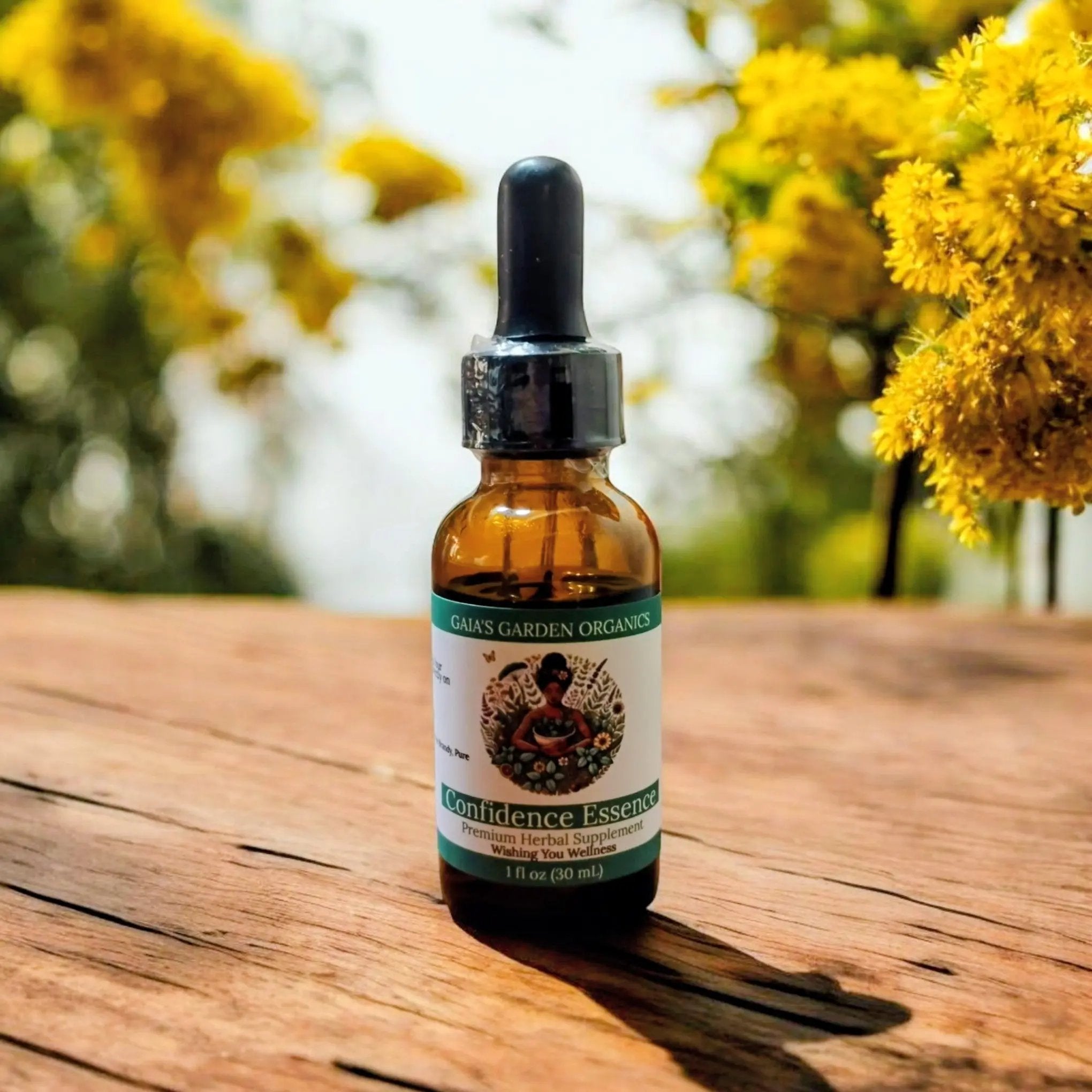
Ours is made from goldenrod grown in our medicine garden in Umpire, Arkansas, with spring water from the property. We sell it as Confidence Essence, $36 for a 1 fl oz bottle.
What is in the bottle is water, brandy, and the sun-infused imprint of the flower. No measurable plant chemistry. No goldenrod smell. This is the part that trips people up, and it is worth sitting with: an essence is not a dilute herbal preparation. It is a different category of medicine, working on the emotional layer rather than on the body's chemistry.
That distinction matters more with goldenrod than with most plants, because goldenrod's herbal reputation and its essence indication have almost nothing to do with each other. As a tea or tincture it is used for entirely different territory, which the goldenrod monograph covers in full, along with the botany, the species question, and the late-summer allergy myth that follows this plant around. Buying the herb when you wanted the essence is the most common mistake I see with goldenrod.
One note worth making here, since it is the first question people ask: a finished flower essence contains no measurable pollen or plant matter at all, so the hay-fever question does not really reach the essence either way.
The pattern goldenrod essence is matched to
Here is the clinic version. A woman comes in who is competent everywhere. She runs a department, or a household, or both. She is the person other people rely on. And when I ask her what she wants, she genuinely does not know, because she has spent so long calibrating to the room that her own preference has gone quiet.
That is the goldenrod pattern. Not shyness. Not low self-esteem in the flat sense. A specific loss of your own outline when other people are present.
What it tends to look like:
- You say yes and then feel the resentment arrive about four hours later.
- In a group, your opinion quietly becomes whatever keeps the peace.
- You rehearse ordinary requests for days before making them.
- You can advocate fiercely for other people and not at all for yourself.
- Alone you know exactly what you think. In the room, it evaporates.
- You apologize for taking up space, including in emails, including right now.
Goldenrod's signature, in the way traditional flower essence practitioners read plants, is that it stands upright and unmistakably itself in a crowded field. That is the quality the essence is used to support: holding your own ground without having to harden to do it.
I have written the longer clinical treatment of this pattern in when you cannot say no. If the list above described your week, read that one next. This page will stay on the essence.
Who goldenrod essence is not for
I would rather you buy nothing than the wrong bottle.
- If the problem is a wound-up, tight-chested nervous system, that is lavender. See Tranquility Essence.
- If the problem is fog and scattered focus, that is peppermint. See Clarity Essence.
- If you are grieving, the heart needs a different plant first. See Heartful Essence.
- If you are simply out of gas, depleted rather than deferential, that is spearmint. See Vitality Essence.
- If the boundary problem sits inside an abusive or coercive situation, an essence is not the intervention. Please get real-world support. The essence can sit alongside that work; it cannot replace it.
Not sure? The Boundary-Type Quiz is free.
How to take Confidence Essence
- Standard daily dose. Four drops, one to two times per day, morning and evening. Under the tongue, in a glass of water, on the pulse points of the wrist, or on food.
- Loading dose for the first three days. Four drops, two to three times per day for the first 72 hours.
- Before the hard conversation. This is the essence people carry in a pocket. Drops can be repeated every 10 to 15 minutes in an acute moment. There is no overdose risk.
- Combining. Up to three essences at once, dropped into the same glass of water.
One clinical note specific to this pattern. Take the morning dose before you check your messages, not after. The goldenrod pattern is a calibrating pattern, and by the time you have read twenty requests you have already begun shaping yourself around them. The dose lands differently when it comes first.
A 1 fl oz bottle holds roughly 600 drops, which is four to five months of consistent daily use.
What to expect, and when
This one has a distinctive arc, and I want you prepared for the middle of it.
- Week 1. Usually nothing dramatic. The most common first report is noticing the yes as it leaves your mouth, which you did not used to catch until hours later. Noticing is the whole first step.
- Weeks 2 to 3. The pause appears. A beat between the request and your answer. It feels awkward. It is the entire mechanism.
- Weeks 3 to 5. Often uncomfortable, and this is the part people are not warned about. Old resentment tends to surface once the accommodating reflex loosens, and it can arrive with more heat than you expect. This is not the essence making you angry. It is anger that was already there becoming available to you.
- Weeks 6 to 8. The steadier place. Saying no stops requiring a rehearsal, and it stops requiring hardness. That combination is what goldenrod is actually for.
If week four feels worse than week one, that is the expected shape of this particular work, not a sign to stop. The general onset timeline across all five essences, including what to do if nothing has shifted after 30 days, is at how long flower essences take to work.
The practice I pair it with
In Yoga Therapy, the anchor for this pattern is Steadiness (Sthira, STHEE-rah), from Patanjali's sutra sthira sukham asanam, usually translated as "the seat should be steady and at ease." Most people meet Sthira on a mat. It is far more useful off one.
The practice, off the mat, is small:
- When a request arrives, take one full breath before answering. One. That is the whole practice.
- During that breath, notice where your weight is. Most people in this pattern lean, physically, toward the person asking.
- Answer from where you actually are, not from where you leaned.
Pair it with Truthfulness (Satya, SUT-yah), the second yama, which in this context means the smallest true answer rather than the most agreeable one. "Let me think about it" is a true answer. It is often the most honest thing available in the moment, and it buys back the pause the pattern took away.
Alcohol, pregnancy, children, and dogs
- Alcohol. Brandy is the preservative, and the amount in a four-drop dose is very small. If you avoid alcohol entirely, drop the dose into warm water and let it sit for two minutes before taking it.
- Pregnancy and nursing. Flower essences are considered low-risk and non-reactive, because they work on the emotional body rather than through biochemistry. The brandy carrier is the only caveat. Tell your healthcare provider what you are taking.
- Medications. Considered non-reactive with conventional medications; essences do not act on the same biochemical pathways. Tell your provider anyway.
- Asteraceae sensitivity. Goldenrod is in the daisy family, alongside ragweed, marigold, and chamomile, and our monograph advises people with severe allergies to other Asteraceae plants to introduce goldenrod in herbal form in small amounts. A finished essence contains no measurable plant matter, so that caution belongs to the tea and tincture rather than to the drops, not to Confidence Essence.
- Children. One to two drops diluted in water, juice, or tea, one to two times a day.
- Dogs and cats. Two to four drops in the water bowl, on food, or on pulse points such as inside the ears or the paw pads. Avoid dosing small pets directly in the mouth. Talk to your veterinarian about ongoing behavioral concerns.
Where to go from here
- Step 1 (free). Take the Boundary-Type Quiz and I will match you to the essence for your actual pattern.
- Step 2 (30-night guarantee). Confidence Essence, four drops morning and evening, for a minimum of six weeks given the arc above. Bach method, brandy and mountain water, made in our garden. Backed by the 30-night guarantee.
- Step 3. Harmony Within, my Yoga Nidra book, for the Sankalpa work that sits underneath a boundary practice.
Flower essences are traditional emotional support and are not a substitute for medical, psychiatric, or safety-related care. If you are in an unsafe situation, please seek real-world support first.
Frequently asked
What is goldenrod flower essence used for?
Emotionally, for the loss of your own outline in the presence of other people. It is the essence for someone who is competent everywhere, who other people rely on, and who cannot locate their own preference once they are in a room. Signs include agreeing and then feeling resentment hours later, rehearsing ordinary requests for days, advocating fiercely for others and not at all for yourself, and apologizing for taking up space. It is not for shyness or flat low self-esteem.
Is goldenrod flower essence the same as goldenrod tea?
No. They share a plant and almost nothing else. Goldenrod as a tea or tincture contains measurable plant compounds and is used for entirely different territory, with its own cautions around kidney and heart conditions, diuretic medications, and pregnancy. The flower essence contains no measurable plant chemistry and is used for an emotional pattern. Buying the herb when you wanted the essence is the most common mistake with this plant.
Does goldenrod cause hay fever?
Goldenrod is widely blamed for late-summer hay fever, and our goldenrod monograph addresses that reputation directly under 'the allergy myth'. For the essence specifically the question does not really apply, because a finished flower essence contains no measurable pollen or plant matter at all. If you have a known severe allergy to other daisy-family plants, that caution applies to goldenrod in herbal form.
How long does goldenrod flower essence take to work?
Week one is usually undramatic; the common first report is catching the yes as it leaves your mouth instead of noticing hours later. Weeks two to three, a pause appears between the request and your answer. Weeks three to five are often uncomfortable, because old resentment tends to surface once the accommodating reflex loosens; that is expected and is not the essence making you angry. Weeks six to eight is the steadier place. Give this one at least six weeks.
Can children take goldenrod flower essence?
Yes. The dose for children is one to two drops diluted in water, juice, or tea, one to two times a day. If you are avoiding alcohol, add the drops to warm water and let it sit two minutes before giving it. It is often used with children and teens navigating peer pressure or difficulty standing up for themselves.
Products from this article
Handcrafted in Umpire, Arkansas by Gaia Devi, clinical herbalist.
Explore our apothecary
Learn more
Flower Essences 101
A clinical herbalist's plain-English guide to what flower essences are and how to take them.
Find your match
The Boundary-Type Quiz
5-question clinical-herbalist diagnostic for the recovering people-pleaser. Matches a 7-day boundary practice to your pattern.
Shop the apothecary
The 5-Essence Starter Cabinet
All 5 essences bundled at 20% off, the full emotional toolkit.
Sources & further reading
Authoritative references consulted in writing this article. Open in a new tab.
- The Bach CentreHistory of the Bach Flower Remedies
- Chestnut School of Herbal MedicineFlowering Herbs (article archive)
- NCCIHDietary and Herbal Supplements