Herb glossary · for the depleted caretaker
Spearmint
Mentha spicata
Family: Lamiaceae · Parts used: Leaf
Spearmint (Mentha spicata) is the gentler, sweeter cousin of peppermint, a soft aromatic carminative with a unique modern application: clinical-trial-supported reduction of androgen-related hirsutism in women with PCOS.
Traditional uses
Spearmint (Mentha spicata) is the older, gentler, more universally cultivated mint, the one that flavors most commercial mint products and grows in most herb gardens. It contains carvone rather than the menthol that gives peppermint its sharp coolness, and as a result has a quite different therapeutic personality despite the family resemblance. Spearmint has been a Mediterranean and Middle Eastern household herb since at least Roman times, and has emerged in the past two decades as one of the more interesting herbs in modern women's health research.1
Primary therapeutic territory: PCOS and androgen-related symptoms
The most striking modern clinical application of spearmint is in polycystic ovary syndrome (PCOS), particularly the hirsutism (unwanted facial and body hair growth) component. Two double-blind randomized controlled trials in women with PCOS-related hirsutism found that twice-daily spearmint tea over 30 days produced statistically significant reductions in free and total testosterone alongside subjective improvements in hirsutism. The effect appears to be a mild anti-androgenic action.2 This is a relatively unusual situation in herbal medicine, a culinary herb with serious clinical-trial support for a specific condition.
Other traditional uses
- Gentle digestive support. Spearmint shares peppermint's carminative quality but more softly, useful for digestive complaints in people who find peppermint too cooling or who have acid reflux that peppermint worsens.
- Pediatric digestive upset. The gentler intensity makes spearmint a more appropriate choice than peppermint for young children's tummy aches.
- Memory and cognitive support. A small body of human research has explored standardized spearmint extract for age-related working-memory support in older adults.
- Mild calming aromatic. Spearmint has a softer nervous-system profile than peppermint, slightly settling rather than stimulating.
- Cooling support during hot flashes. Like peppermint, spearmint creates a mild felt-cooling sensation, useful for perimenopausal hot flashes, particularly when paired with hibiscus or rose.
The flower essence connection
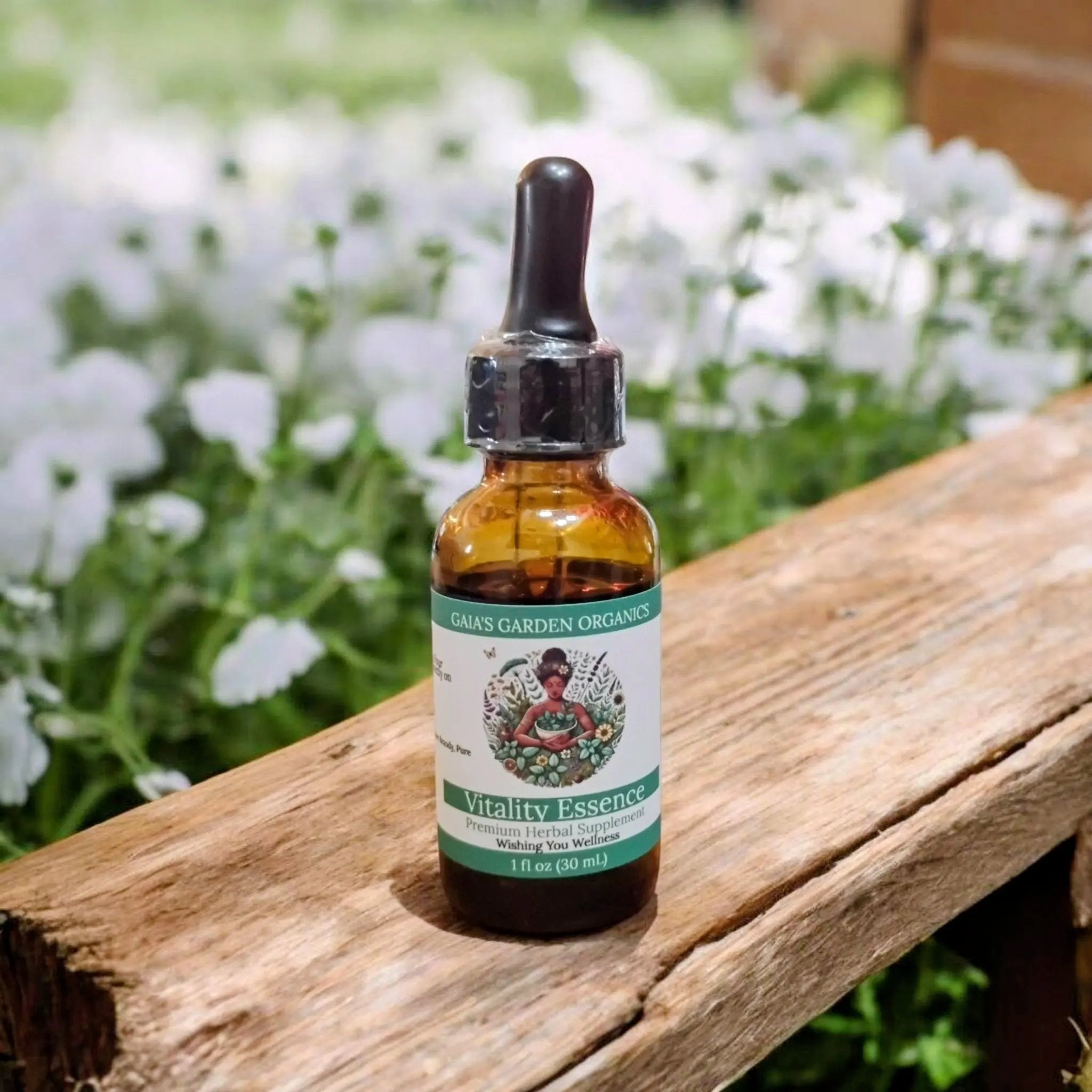
Spearmint is the flower used to prepare our Vitality Essence. The herbal-tea preparation works through spearmint's chemical constituents (carvone, rosmarinic acid, anti-androgenic compounds); the flower essence operates on the emotional level around burnout, exhaustion, and renewed lightness. The two preparations share a "fresh and reviving" personality but reach the body and psyche by different pathways.
How we use spearmint at Gaia’s Garden
At Gaia's Garden Organics, spearmint (Mentha spicata) grows in our medicine garden in Umpire, Arkansas. We harvest it ourselves, by hand, at the moment its medicine is at peak.
In our formulas
Gaia's Vitality Essence - Organic Spearmint Flower Essence: Traditionally used to support lightness, renewed joy, and a sense of returning vitality during flat or heavy seasons. Spearmint's softer cousin-to-peppermint personality makes it gentle enough for the most sensitive systems.
Safety & considerations
Spearmint has an exceptionally clean safety profile and is one of the gentlest medicinal herbs available, it appears in the diets of millions of people worldwide as a culinary ingredient with no significant adverse effect record.
Hormonal sensitivity
Because spearmint has measurable mild anti-androgenic activity, anyone with hormone-sensitive conditions (certain cancers, endocrine disorders) should discuss daily spearmint tea with their oncologist or endocrinologist. The effect is gentle but real and worth flagging in clinical contexts.
Pregnancy and lactation
Mild spearmint tea is generally considered safe during pregnancy and breastfeeding in moderate amounts. Concentrated extracts or supplements specifically for hirsutism should be discussed with a midwife or obstetrician.
Drug interactions
Limited documented drug interactions. Theoretical caution with anti-androgen medications (already used for some PCOS treatments) due to potential additive effect; consult your prescriber if combining.
Children and pets
Spearmint is one of the gentlest pediatric digestive herbs and is widely used in children's tea blends. For pets, spearmint tea in small amounts is generally well-tolerated by dogs; concentrated spearmint essential oil should be avoided around cats. Consult your veterinarian.
Frequently asked
Does spearmint really help with PCOS hirsutism?
There is real clinical evidence for this, two double-blind randomized controlled trials have found statistically significant reductions in free and total testosterone in women with PCOS-related hirsutism after 30 days of twice-daily spearmint tea, alongside subjective improvements. The effect is gentle, not dramatic, and works alongside (not instead of) PCOS management with a clinician.
Spearmint vs peppermint, when do I choose which?
Spearmint is gentler, contains carvone rather than menthol, and has unique applications for women's hormone health (PCOS hirsutism, mild anti-androgenic). Peppermint is sharper, has stronger digestive evidence (especially for IBS), but worsens acid reflux. For acid reflux, sensitive children, or anti-androgenic effect: spearmint. For IBS or strong digestive cramping: peppermint.
How much spearmint tea for PCOS?
The clinical trials used twice-daily strong spearmint tea (one cup morning, one evening) over 30 days. Improvements were measured at 30 days; longer-term use likely deepens the effect. This is alongside, not instead of, working with a clinician for PCOS management.
Is spearmint safe for daily long-term use?
For most healthy adults, yes, spearmint has a long tradition of daily culinary and medicinal use. The hormonal sensitivity caveat (hormone-sensitive conditions, anti-androgen medications) is the main exception. Daily use through pregnancy and lactation is generally considered safe in moderate amounts; consult your midwife.
Spearmint tea vs Vitality Essence, which one for energy?
Different mechanisms. Spearmint tea works through aromatic and physiological chemistry, gentle digestive support, mild cooling, mild anti-androgenic effect. The flower essence (Vitality) works on the emotional level around burnout and renewed lightness. Many people use both: tea as a daily ritual, essence for the nervous-system depletion underneath.
Is spearmint safe for kids and pets?
For children, yes, spearmint is one of the most pediatric-friendly digestive herbs and is widely used in children's tea blends for tummy aches and gas. For pets, spearmint tea in small amounts is generally tolerated by dogs; concentrated spearmint essential oil should be kept away from cats. Consult your veterinarian.
References
- Akdoğan M et al. Effect of spearmint (Mentha spicata) tea on androgen levels in women with hirsutism. Phytother Res. 2007;21(5):444-7
- Grant P. Spearmint herbal tea has significant anti-androgen effects in PCOS: a randomized controlled trial. Phytother Res. 2010;24(2):186-8
- Memorial Sloan Kettering About Herbs: Spearmint
- American Botanical Council / HerbalGram
- Mountain Rose Herbs: Spearmint Leaf monograph