In this article (9)▾
A woman sat in my clinic last spring and told me she had tried everything for her nerves. Magnesium. Chamomile. A meditation app she had paid for and stopped opening. She was not in crisis. She held a job, raised two kids, and answered every email. She just could not get her chest to unclench, and she had stopped expecting to.
She had also, at some point, bought a bottle of lavender essential oil, put it on her wrists, and concluded that lavender did not work for her.
That is the confusion this guide is written to clear up. Lavender essential oil and lavender flower essence are not the same medicine. They are not made the same way, they do not contain the same thing, and they do not do the same job. This is a guide to the essence specifically: what it is, who it is genuinely matched to, how to take it, and what actually happens over the first few weeks.
If you have never met flower essences at all, start with our pillar guide, Flower Essences 101, which covers the history and the method in full. This page assumes you have the basics and want the lavender part.
What lavender flower essence actually is
Lavender flower essence is made by floating fresh lavender blossoms (Lavandula angustifolia) on mountain water in direct sun, then preserving the infused water in brandy. That is the traditional Bach method, the clinical gold standard for this work for close to a century. Ours is made from lavender grown in our medicine garden in Umpire, Arkansas, with spring water from the property. If you want the full account of the method, it lives at the Bach method, explained.
What ends up in the bottle is water, brandy, and the sun-infused imprint of the flower. There is no measurable plant chemistry in a finished essence. It does not smell of lavender. It smells faintly of brandy.
That surprises people, and it should. It is the single most important thing to understand before you decide whether this is the right medicine for you. A flower essence works on the emotional layer, not through biochemistry. If you want lavender's biochemical action on the body, you want a tincture or a tea, and those are different products doing different work.
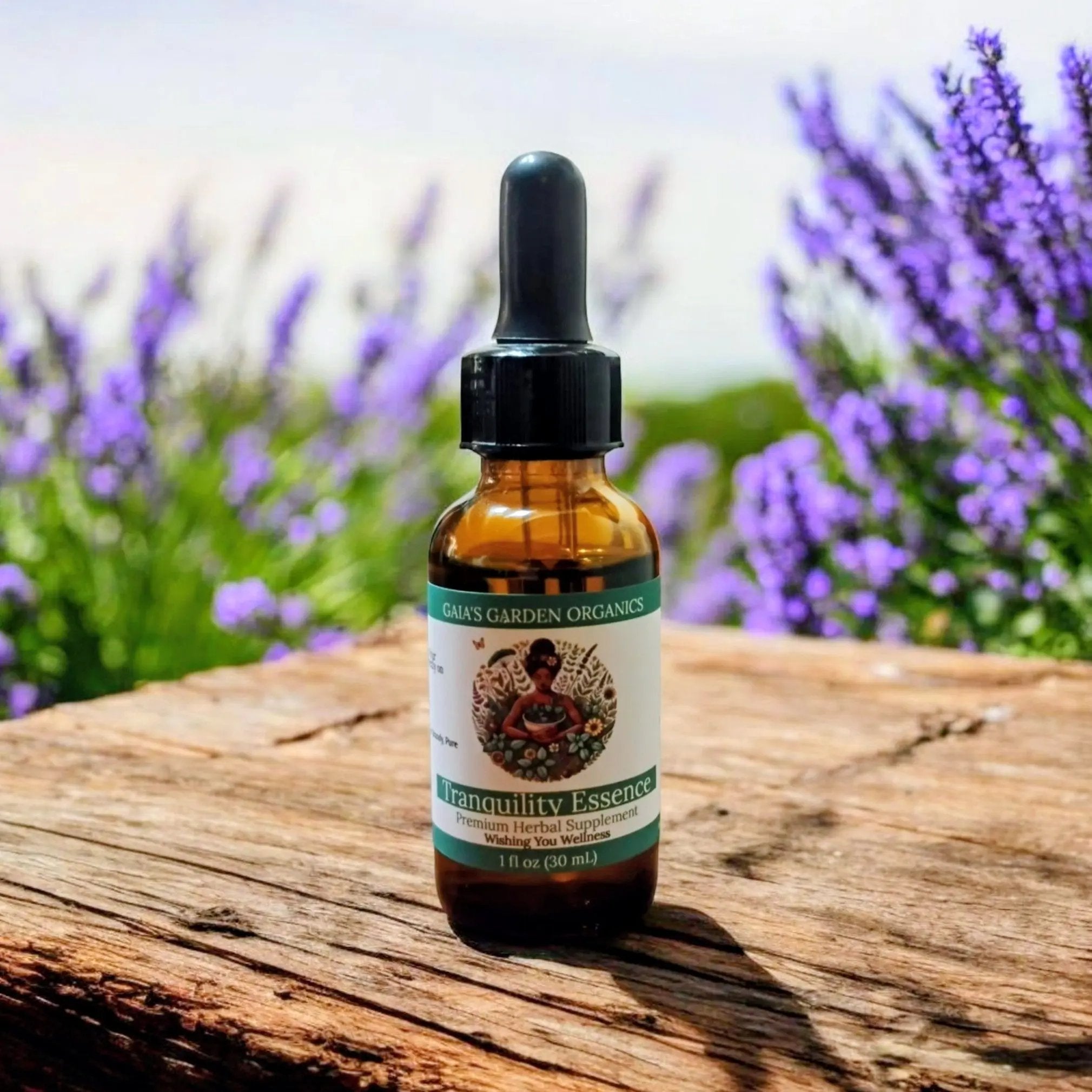
We sell it as Tranquility Essence, $36 for a 1 fl oz bottle.
Why the essence did nothing when the oil did something (or the reverse)
Lavender is the plant people have most often already met, usually as an essential oil, and that prior meeting is exactly what confuses the decision.
The short version: the oil is the plant's perfume, steam-distilled and intensely aromatic, working through smell and skin. The tea or tincture is the plant's medicine cabinet, containing measurable compounds that act on the body's chemistry. The essence is the plant's signature, with no aroma and no measurable plant matter, working on the emotional pattern rather than on tissue.
So if you put lavender oil on your wrists, felt a pleasant twenty minutes, and concluded lavender does not work for you, you have learned nothing about the essence. You tested a different medicine. The reverse is also true: people who love the essence sometimes assume the oil will do the same job, and it will not.
The full side-by-side is at flower essences vs essential oils, and the plant's own botany, constituents, and herbal cautions are in the lavender monograph.
The pattern lavender essence is matched to
In clinic I do not match essences to diagnoses. I match them to patterns, and the lavender pattern is specific.
It is the person whose nervous system will not come down off the ledge. Not panic. Not collapse. A steady, low, humming over-alertness that has been running so long it stopped feeling like a symptom and started feeling like a personality.
What it tends to look like:
- The chest stays tight even on a good day, and even when nothing is wrong.
- You fall asleep fine and then wake at 2am with the mind already mid-sentence.
- Small sounds, sudden noises, and abrupt changes of plan land harder than they should.
- You are told to relax and you do not know, physically, how to do that.
- Rest does not restore you, because you never fully put the guard down.
- The anxiety sits lower than your thoughts, so talking yourself out of it does not reach it.
That last one is the tell. When the anxious feeling lives underneath language, reasoning with it does not work, and people conclude they are failing at something. They are not. They are aiming a verbal tool at a non-verbal problem.
I have written the full clinical treatment of that pattern separately, in the chest that will not soften. If the description above is landing hard, read that one next; this page will stay on the essence itself.
Who lavender essence is not for
I would rather you buy nothing than buy the wrong bottle, so here is the honest disqualification list. Lavender is not the match if:
- You are flat and depleted rather than wound up. If the problem is that nothing lights up, that you are running on fumes after a long stretch of giving, that is the spearmint territory. See Vitality Essence.
- Your problem is fog, not tension. If your mind is scattered and slow rather than fast and tight, look at Clarity Essence instead.
- You are grieving. Grief has its own arc and its own plant. That is Heartful Essence.
- You cannot say no, and the anxiety is downstream of that. That is a boundary pattern, and goldenrod is the better match. See Confidence Essence.
- You are in acute crisis. If you are in danger, or the anxiety is disabling, please get human clinical care. An essence is a daily anchor. It is not an emergency intervention and I will not pretend otherwise.
If you are not sure which pattern is yours, the Anxiety-Type Quiz is free and takes a few minutes.
How to take Tranquility Essence
The traditional protocol is simple and it has not changed much in ninety years.
- Standard daily dose. Four drops, one to two times per day. Morning and evening is ideal. Under the tongue, into a glass of water, onto the pulse points of your wrist, or onto food.
- Loading dose for the first three days. Four drops, two to three times per day for the first 72 hours of a new essence. This helps it settle in faster.
- Acute moments. During a hard conversation, a thunderstorm, or a spike of dread, the drops can be repeated every 10 to 15 minutes. There is no overdose risk. Essences work on the emotional body, not pharmacologically.
- Combining. Up to three essences at once. Drop each into the same glass of water and sip through the day, or take them separately on pulse points.
Two practical notes. First, the timing matters more than the amount. Twenty drops at once does not do twenty times the work; a consistent daily rhythm does almost all of it. Second, a 1 fl oz bottle holds roughly 600 drops, which is four to five months of steady daily use, so this is a slower and cheaper commitment than most people assume.
What to expect, and when
People quit essences in week two because they expected week six. Here is the honest arc.
- First dose to day 3. Acute shifts are often felt within 15 to 20 minutes, and they are subtle. Usually it is a small drop in reactivity rather than a wave of calm. Many people feel nothing at all in this window, which is not a failure.
- Week 1. The most common first report is not "I feel calm." It is "I did not snap at the thing that usually makes me snap." Watch your reactivity, not your mood.
- Weeks 2 to 4. This is where chronic-pattern work actually shows up. Sleep often changes before daytime feeling does. The 2am waking gets shorter, or you get back down faster.
- Weeks 4 to 8. The baseline moves. The guard comes down a little in situations where it used to stay up. This is the change worth staying for.
Track it in writing if you can. The shifts here are quiet enough that memory alone will miss them, and people routinely underrate their own progress. If you want the general onset timeline across all five essences, including what to do if nothing has happened after 30 days, that is covered in how long flower essences take to work.
The practice I pair it with
An essence is an anchor, not a whole protocol. In my Yoga Therapy practice, the pairing for this pattern is Long-Exhale Breath (Vishama Vritti, vish-AH-mah VRIT-tee), which simply means a deliberately uneven breath where the exhale runs about twice as long as the inhale.
The version I teach for a wound-up nervous system takes about two minutes:
- Sit or lie down. Take the drops first, then settle.
- Inhale through the nose for a count of four.
- Exhale through the nose for a count of eight. Let the count be comfortable; if eight strains, use six.
- Ten rounds. Notice the weight of your shoulders rather than trying to relax them.
Do this at the evening dose. The essence and the breath are working the same layer from two directions, and the combination is more useful than either alone.
Alcohol, pregnancy, children, and dogs
The questions I get most, answered plainly.
- Alcohol. Brandy is the preservative and it is what makes the essence shelf-stable for years without refrigeration. The amount in a four-drop dose is very small. If you avoid alcohol entirely, drop the dose into warm water and let it sit two minutes before taking it.
- Pregnancy and nursing. Flower essences are considered low-risk and non-reactive during pregnancy and nursing, because they work on the emotional body rather than through biochemistry. The brandy carrier is the only caveat. Tell your healthcare provider what you are taking.
- Medications. Essences are considered non-reactive with conventional medications; they do not act on the same biochemical pathways. Still tell your provider. Never stop a prescribed medication without medical supervision.
- Lavender the herb has its own cautions. Lavender tea and tincture carry notes around sedative medications and hormone-sensitive conditions that belong to the plant's chemistry rather than to Tranquility Essence, which contains no measurable plant chemistry. If you take lavender in herbal form as well, read the safety section of the lavender monograph.
- Children. One to two drops diluted in water, juice, or tea, one to two times a day.
- Dogs and cats. Two to four drops in the water bowl, on food, or applied to pulse points such as inside the ears or on the paw pads. Avoid dosing small pets directly in the mouth. For ongoing behavioral or medical concerns, talk to your veterinarian.
Where to go from here
- Step 1 (free). Not sure lavender is your match? Take the Anxiety-Type Quiz and I will point you at the essence for your actual pattern.
- Step 2 (30-night guarantee). Tranquility Essence, four drops morning and evening, for a minimum of four weeks. Prepared by the traditional Bach method in brandy and mountain water. If it is not right for you, the 30-night guarantee covers it.
- Step 3. Harmony Within, my Yoga Nidra book, for the deeper nervous-system work the essence is supporting.
Flower essences are traditional emotional support and are not a substitute for medical or psychiatric care. If your anxiety is severe, disabling, or worsening, please work with a clinician.
Frequently asked
Is lavender flower essence the same as lavender essential oil?
No, and this is the most common mix-up with this plant. Essential oil is steam-distilled, intensely aromatic, and concentrated; it works through smell and skin and is generally diffused or diluted rather than swallowed. Flower essence is sun-infused water preserved in brandy, with no aroma and no measurable plant chemistry, taken as drops and working on the emotional layer. If you tried lavender oil and felt nothing lasting, that tells you nothing about whether the essence fits you. You tested a different medicine.
How many drops of lavender flower essence should I take?
Four drops, one to two times per day, morning and evening being ideal. Take them under the tongue, in a glass of water, on the pulse points of the wrist, or on food. For the first 72 hours of a new essence, a loading dose of four drops two to three times per day helps it settle in faster. In an acute moment the drops can be repeated every 10 to 15 minutes. There is no overdose risk, because essences work on the emotional body rather than pharmacologically.
How long does lavender flower essence take to work?
Acute shifts are often felt within 15 to 20 minutes and are subtle, usually a small drop in reactivity rather than a wave of calm. The change most people are actually after shows up over weeks two to four of consistent daily use, and sleep often changes before daytime feeling does. Weeks four to eight is where the baseline moves. Track it in writing; the shifts are quiet enough that memory alone will miss them.
Can I take lavender flower essence with my medications?
Flower essences are considered non-reactive with conventional medications, because they do not act on the same biochemical pathways. Tell your healthcare provider what you are taking anyway, and never stop a prescribed medication without medical supervision. Note that lavender as a tea or tincture is a different matter and carries its own notes around sedative medications and hormone-sensitive conditions; those belong to the plant's chemistry, not to the essence.
Who should not use lavender flower essence?
It is the wrong match if you are flat and depleted rather than wound up, which is spearmint territory; if your problem is mental fog rather than tension, which is peppermint; if you are grieving, which is rose; or if the anxiety sits downstream of not being able to say no, which is goldenrod and a boundary pattern. It is also not an emergency intervention. If anxiety is disabling or you are in danger, please get human clinical care.
Products from this article
Handcrafted in Umpire, Arkansas by Gaia Devi, clinical herbalist.
Explore our apothecary
Learn more
Flower Essences 101
A clinical herbalist's plain-English guide to what flower essences are and how to take them.
Find your match
The Anxiety-Type Quiz
5-question clinical-herbalist diagnostic that names your anxiety pattern and matches a practice + plant pairing.
Shop the apothecary
The 5-Essence Starter Cabinet
All 5 essences bundled at 20% off, the full emotional toolkit.
Sources & further reading
Authoritative references consulted in writing this article. Open in a new tab.
- The Bach CentreHistory of the Bach Flower Remedies
- The Bach CentreWhat are the sun and boiling methods?
- NCCIHDietary and Herbal Supplements