In this article (7)▾
Modern wellness teas borrow from a small set of well-established traditional herbs. Most "new" tea formulas re-combine herbs that have been part of clinical herbal medicine for centuries. This guide is a tour through the traditional ingredients that anchor most of our blends, and why these herbs have stayed in clinical practice.
The nervine cluster
For anxiety, sleep, and emotional support, four classical herbs:
- Chamomile (Matricaria recutita): The gentle bedtime herb across European tradition. Recent RCT evidence (Amsterdam 2009, Mao 2016) supports its use for generalized anxiety.
- Lemon Balm (Melissa officinalis): "The gladdening herb" of Greek medicine. Gentle nervine; supports calm focus without sedation.
- Passionflower (Passiflora incarnata): The racing-mind herb. American eclectic and modern clinical research support its use for anxiety and sleep onset.
- Lavender (Lavandula angustifolia): The body-clench herb. Crosses traditions; used aromatically, topically, and as tea.
The respiratory cluster
- Mullein (Verbascum thapsus): Classical lung tonic across American and European traditions.
- Marshmallow Root (Althaea officinalis): Demulcent for irritated mucous membranes.
- Thyme (Thymus vulgaris): Antimicrobial respiratory herb with volatile-oil action.
- Elderflower (Sambucus nigra): Upper-respiratory ally for cold and flu symptoms.
The cardiovascular cluster
- Hawthorn (Crataegus): European tradition's heart tonic. Modern research (HERB CHF, Pittler 2008 Cochrane) supports mild heart failure use.
- Rose (Rosa spp.): Heart medicine across nearly every herbal tradition. Both for the physical heart and for the emotional layer.
- Hibiscus (Hibiscus sabdariffa): Strongest evidence for blood pressure reduction (McKay 2010 RCT, 2021 meta-analysis).
- Motherwort (Leonurus cardiaca): The cardiac nervine for anxiety-driven palpitations.
The adaptogen cluster
- Tulsi (Ocimum tenuiflorum): "Queen of herbs" in Ayurveda. Modulates the stress-cortisol response.
- Ashwagandha (Withania somnifera): Grounding Ayurvedic adaptogen. RCT evidence for cortisol reduction.
- Rhodiola (Rhodiola rosea): The cognitive-fatigue adaptogen.
- Eleuthero (Eleutherococcus senticosus): Russian adaptogenic tradition for endurance and long-arc recovery.
The digestive cluster
- Ginger (Zingiber officinale): Warming, motility-supporting, anti-nausea. Universal across cultures.
- Peppermint (Mentha piperita): Cooling, antispasmodic, gas-relieving.
- Fennel (Foeniculum vulgare): Carminative for bloating and gas.
- Marshmallow Root: Demulcent for gastritis and reflux.
Why these herbs last
The traditional ingredients keep showing up in clinical formulas because they have stood the test of centuries of use. New herbs come and go; the classical herbs persist because they consistently do what they are reputed to do, with safety profiles that match daily tea use.
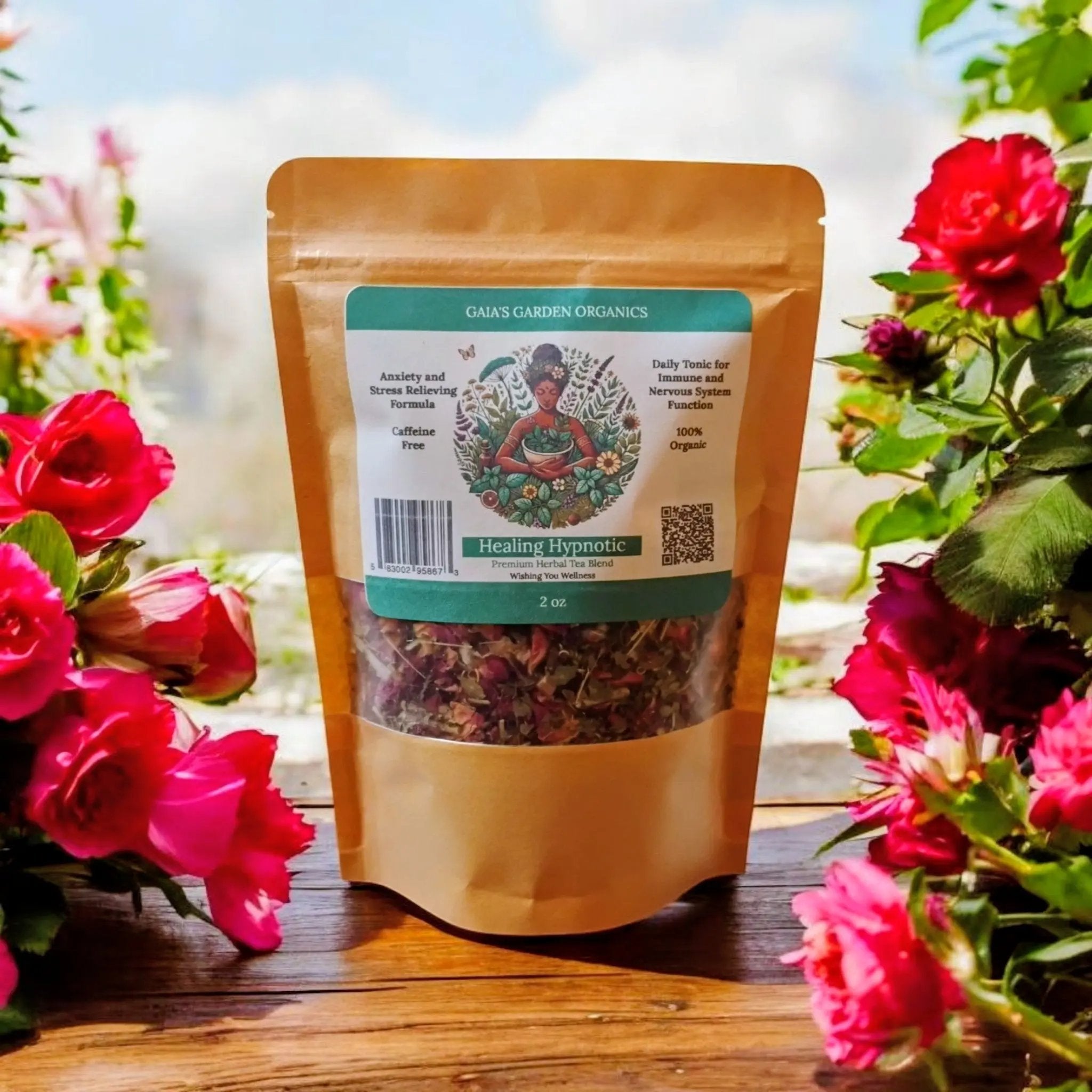
Most of our blends are built around these classical clusters: Healing Hypnotic Tea around the nervine cluster, Breathe Better Tea around the respiratory cluster, Magical Marvel Tea around the anti-inflammatory and gut cluster. I do not currently make a blend for the cardiovascular cluster or the seasonal-immune cluster, and I would rather name that plainly than push you toward a cup built for a different job. Those two clusters are well worth learning to blend at home.
Where to go from here
- Step 1 (free): Match your essence in 7 questions. Take the essence quiz.
- Step 2 (30-night guarantee): Browse all our herbal teas by the pattern they support: anxiety, sleep, heart, respiratory, immune, or energy.
- Step 3 (coming soon): Harmony Within, my Yoga Nidra book.
For broader context, our pillar guide Herbal Teas 101 covers preparation, dosing, and how to choose between blends.
Frequently asked
Why does almost every wellness brand use similar herbs?
Because the well-evidenced and well-tolerated herbs cluster into a relatively small set. Across centuries of clinical herbal medicine, the same plants keep coming back because they work reliably for their stated uses. Modern wellness products draw on the same classical pharmacopoeia; the differences between brands are usually in sourcing quality, formulation expertise, and dosing accuracy rather than novel ingredients.
Are exotic herbs better than common ones?
Almost never. The most-effective herbs for most adults are the well-established traditional ones; exotic and novel herbs often have less evidence and less safety data. A well-made chamomile tea is more useful than a novel herb with viral marketing. The exceptions are specific Ayurvedic and Chinese herbs that bring genuinely different mechanisms (ashwagandha, rhodiola, schisandra), but even these are now well-studied.
Can I make my own blend from these classical herbs?
Yes, once you understand which herbs match which pattern. The simpler the blend, the easier to evaluate. Start with two or three herbs in a single formula rather than ten; you'll learn faster what each herb actually does. Our blends typically run 3-5 herbs at clinical-strength doses; this is the sweet spot between specificity and complexity.
Why don't your blends contain valerian, kava, or other strong sedatives?
Valerian causes paradoxical agitation in roughly 10 percent of users; we use Skullcap instead for that reason. Kava is hepatotoxic in chronic use; we avoid it. Other 'strong sedative' herbs often have safety concerns at therapeutic doses. The herbs in our blends are chosen for their combination of effectiveness and safety at daily-tea doses.
How do I know if a tea brand is using quality ingredients?
Look for: organic certification, specific genus-and-species labeling, country of origin or local sourcing, transparent dosing on the label, and recent harvest dates. Avoid: 'natural flavors,' unidentified blends without species names, and brands that don't tell you who made the product. Quality herbal medicine has a person attached to it; mass-produced anonymity is usually a sign of mass-produced quality.
Products from this article
Handcrafted in Umpire, Arkansas by Gaia Devi, clinical herbalist.
Explore our apothecary
Learn more
Flower Essences 101
A clinical herbalist's plain-English guide to what flower essences are and how to take them.
Find your match
The Anxiety-Type Quiz
5-question clinical-herbalist diagnostic that names your anxiety pattern and matches a practice + plant pairing.
Shop the apothecary
Medicinal Herbal Teas
Loose-leaf, clinical-herbalist-blended teas, each built around a specific job.
Sources & further reading
Authoritative references consulted in writing this article. Open in a new tab.
- NCCIHHerbs at a Glance (per-herb safety and evidence)
- NCCIHDietary and Herbal Supplements
- Chestnut School of Herbal MedicineFlowering Herbs (article archive)
- Chestnut School of Herbal MedicineThe Best Home Herbal Apothecary Books