In this article (5)▾
You are tired by 9pm but wired by 11pm. You lie down and the body settles, then the mind starts narrating. You wake at 2am with your jaw clenched and an unanswered email looping in your head. By 6am you give up.
This is the sleep-anxiety overlap. It is the most common reason adults end up in my clinic for sleep work. The pattern is not melatonin deficiency; the body knows it is bedtime. The pattern is a nervous system still running in sympathetic mode (the "on" branch) when it should have switched to parasympathetic (the "off" branch) two hours ago.
This guide is about why a herbal tincture works for this pattern in a way that teas and capsules don't, what to look for in the formula, and how to build the evening ritual where the tincture becomes the daily switch that ends the loop.
Why tinctures, not teas or capsules
All three forms of herbal medicine work. They just work on different timelines for different uses.
- Tea: Slow, low-dose, gentle. Excellent for daily ritual but the active compound load per cup is modest. Best for general nervous-system support across the day, not for hitting the actual sleep-onset window.
- Capsule (dried herb): Standardized but slow-acting. Has to pass through the digestive tract and be broken down before the active compounds reach circulation. Onset is 30-60 minutes minimum, often longer.
- Tincture (alcohol extract): Sublingual absorption begins under the tongue within minutes. The active compounds bypass first-pass liver metabolism. Onset is 15-30 minutes. The bioavailability is significantly higher than capsules at the same herb load.
For the sleep-anxiety pattern specifically, you want something that lands inside the wind-down hour, not something that kicks in three hours later when you are already lying awake. The tincture wins on timing.
What the formula needs to do
A working sleep-anxiety tincture needs to handle two layers at once, the mental loop and the physical clench. If it handles only one, you fall asleep but wake at 3am (mental layer untreated) or your mind quiets but your jaw still aches (physical layer untreated).
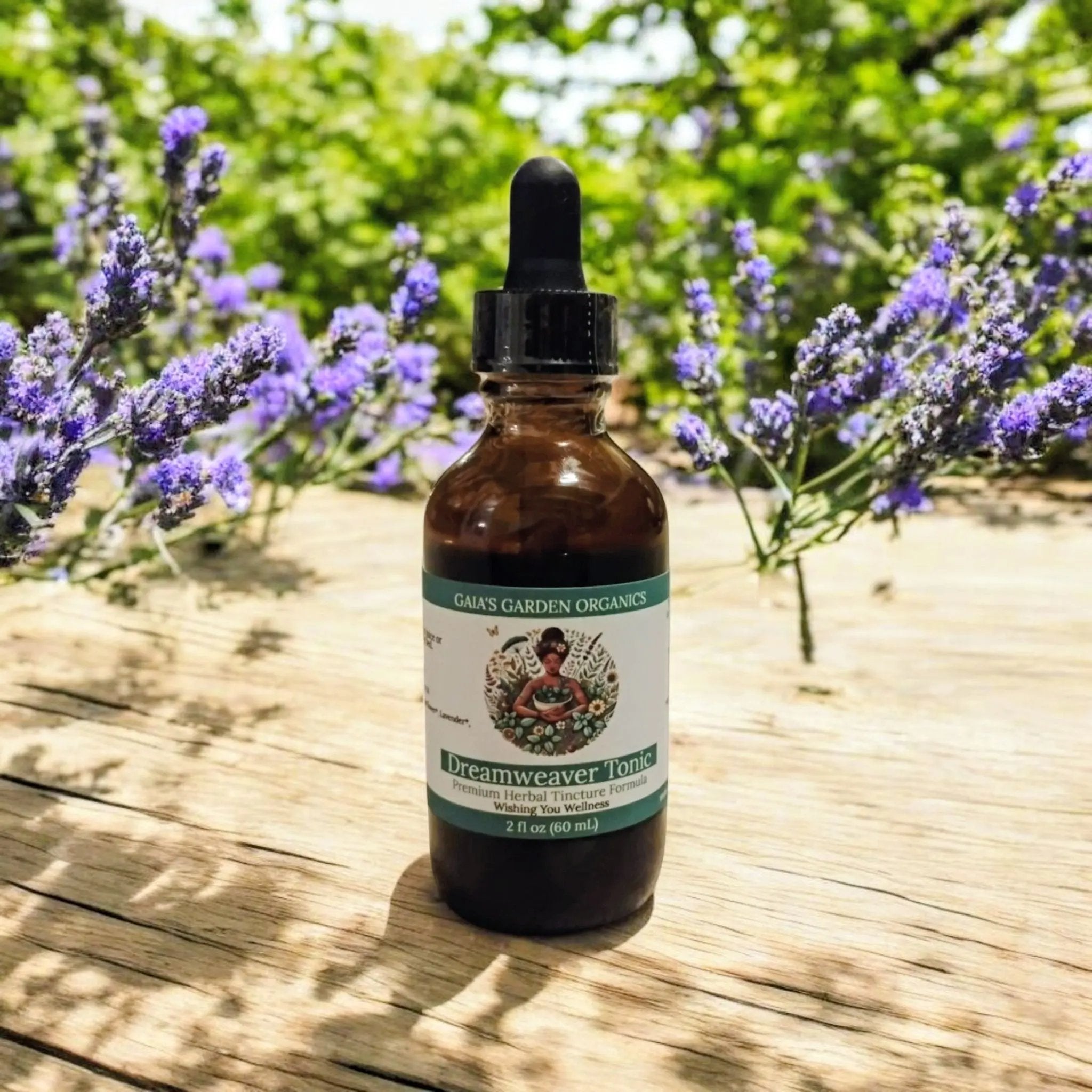
The two herbs I formulate Dreamweaver Tonic around are Skullcap and Lavender.
- Skullcap (Scutellaria lateriflora): The American eclectic nervine specifically for "the bedtime mind that will not stop reviewing the day." It calms without sedating; it does not knock you out. A 2014 randomized controlled trial demonstrated measurable mood improvement with no side effects.
- Lavender (Lavandula angustifolia): The body half of the work. Where Skullcap quiets mental looping, Lavender unwinds the physical clench. The jaw drops. The shoulders find their natural line. The chest opens.
Two herbs at clinical-strength weight-to-volume extraction, calibrated for each plant. Most sleep blends cram five to ten herbs into the same ounce of tincture, which dilutes each herb below the threshold where it actually does its job. Dreamweaver doses the two herbs properly.
The evening ritual that makes the tincture work
The tincture is not a sleeping pill. It is a daily ritual cue plus a pharmacological assist. The ritual is what teaches your nervous system that the day is closing; the tincture is what helps the system actually downshift.
- 90 minutes before bed: Lights down to one warm lamp. Phone parked outside the bedroom (or on grayscale + Do Not Disturb).
- 60 minutes before bed: Two to three droppersful of Dreamweaver in a small glass of water. Sip slowly. Notice the breath deepen as the herbs land.
- 45 minutes before bed: A 5-minute body-scan or a few rounds of long-exhale breathing (inhale 4, exhale 6 to 8). The herbs and the breath compound each other.
- 30 minutes before bed: Body in bed. Cool room, around 65 to 68 degrees. The body falls asleep against a cooling room.
- If you wake at 3am: One dropperful of Dreamweaver in a sip of water. Long-exhale breathing for 2 minutes. Most clients drop back to sleep within 15-20 minutes.
What you'll notice across the first 30 days
- Night 1-3: The wind-down hour starts feeling different. The mental loop softens around the 20-minute mark after the dose. Sleep onset may or may not improve yet.
- Night 4-7: The body recognizes the rhythm. Onset is faster. 2-3am wake-ups still happen but resolve more quickly.
- Week 2-3: Through-the-night sleep on more nights than not. The wind-down hour becomes the part of the day you look forward to.
- Week 4: The new baseline is the default. The tincture stays in the rotation, but the work is mostly done by the ritual itself.
Where to go from here
- Step 1 (free): The 7-Night Sleep Reset PDF, a free clinical-herbalist guide that walks the evening ritual one night at a time. Get the protocol.
- Step 2 (30-night guarantee): Dreamweaver Tonic, two to three droppersful 60 minutes before bed. Dreamweaver Tonic. If anxiety is the root pattern beneath the broken sleep, pair with Tranquility Essence in The 30-Day Calm Reset Kit (Dreamweaver + Tranquility + Healing Hypnotic Tea).
- Step 3 (coming soon): Harmony Within, my Yoga Nidra book. Sleep-onset and 3am-wake scripts.
This guide is for general sleep support and is not a substitute for medical care. If sleep loss is tied to a clinical condition (sleep apnea, restless legs, severe insomnia, depression, chronic pain), please work with a sleep specialist or physician.
For broader context on tinctures vs. teas vs. essences, our pillar guide Herbal Tinctures 101 covers what tinctures are, how they're made, sublingual dosing, and how to choose between the three forms.
Frequently asked
Why does a tincture work faster than a capsule of the same herb?
Sublingual absorption. The tincture's alcohol extract crosses through the mucous membranes under the tongue and enters the bloodstream directly, bypassing first-pass liver metabolism. Capsules have to be swallowed, digested, broken down, and absorbed through the gut wall before any active compound reaches circulation. The same herb at the same dose lands in 15-30 minutes as a tincture and 60-90 minutes as a capsule. For sleep onset specifically, that timing gap is the difference between a working formula and one that kicks in after you have already been lying awake for an hour.
Can I drink alcohol while taking Dreamweaver?
Best to avoid stacking. Dreamweaver's alcohol per dose is small (a few milliliters of organic alcohol in two droppersful) but the Skullcap and Lavender in the formula are both mild central-nervous-system relaxants. Adding alcohol on top can produce more sedation than you want and undermines the parasympathetic shift the tincture is supposed to support. If you do have a glass of wine with dinner, take Dreamweaver at least 2 hours later.
Will I become dependent on the tincture to sleep?
No. Skullcap and Lavender are both non-habit-forming, non-narcotic, and don't develop tolerance. You can take Dreamweaver nightly for years, or stop tomorrow with no withdrawal. Most clients use it nightly for the first 30 days, then continue as part of their wind-down ritual. Others taper to as-needed once the sleep rhythm holds. The bigger anchor is the evening ritual itself; the tincture supports the ritual, not the other way around.
Is this safe with my prescribed sleep or anxiety medication?
Generally yes, but please consult your prescriber first. Skullcap and Lavender are both mild central-nervous-system relaxants, and stacking with prescription sleep medications (zolpidem, eszopiclone, doxepin, trazodone) or benzodiazepines can cause additive sedation. If you're tapering off a prescription sleep aid under medical supervision, Dreamweaver is often used as the bridge support. Never stop psychiatric or sleep medications without your prescriber's guidance.
How is this different from melatonin?
Melatonin tells the body it is bedtime, which is information the body already has at 11pm with the lights off. Melatonin does not address the upstream problem: a nervous system stuck in sympathetic activation at bedtime. Dreamweaver works on that upstream problem. Skullcap quiets the racing mind; Lavender unwinds the physical clench. Sleep arrives because the body actually drops into the parasympathetic state, not because a hormone forces the issue.
Products from this article
Handcrafted in Umpire, Arkansas by Gaia Devi, clinical herbalist.
Explore our apothecary
Learn more
Flower Essences 101
A clinical herbalist's plain-English guide to what flower essences are and how to take them.
Find your match
The Sleep-Type Quiz
5-question clinical-herbalist diagnostic that names your sleep archetype and matches an evening practice + plant pairing.
Shop the apothecary
Herbal Tinctures
Clinical weight-to-volume tinctures for nervous-system, sleep, and recovery work.
Sources & further reading
Authoritative references consulted in writing this article. Open in a new tab.
- PubMed (Amsterdam et al., 2009)A randomized, double-blind, placebo-controlled trial of oral Matricaria recutita (chamomile) extract therapy for generalized anxiety disorder
- PubMed (Mao et al., 2016)Long-term chamomile (Matricaria chamomilla L.) treatment for generalized anxiety disorder: A randomized clinical trial
- PubMed (Akhondzadeh et al., 2001)Passionflower in the treatment of generalized anxiety: a pilot double-blind randomized controlled trial with oxazepam
- PubMed (Brock et al., 2014)American Skullcap (Scutellaria lateriflora): a randomised, double-blind placebo-controlled crossover study of its effects on mood in healthy volunteers
- PubMed (Chandrasekhar et al., 2012)A prospective, randomized double-blind, placebo-controlled study of safety and efficacy of a high-concentration full-spectrum extract of ashwagandha root in reducing stress and anxiety in adults