In this article (10)▾
You lie in bed at 11pm. The day is done. Your body is tired. But the moment the lights go off, the mind starts.
It reviews the conversation you had with your boss. Plans tomorrow's calendar. Drafts an email you forgot to send. Worries about your kid. Replays a regret from 2007. By midnight you are wide awake. By 2am you are checking the clock and doing the math: "if I fall asleep right now I get four hours." You don't fall asleep. The math gets worse.
This is the racing-mind sleep pattern. It is the most common reason adults end up in my clinic. Melatonin doesn't fix it. The Calm app doesn't fix it. Sleep hygiene tips don't fix it. They don't fix it because the problem is not what they're aimed at.
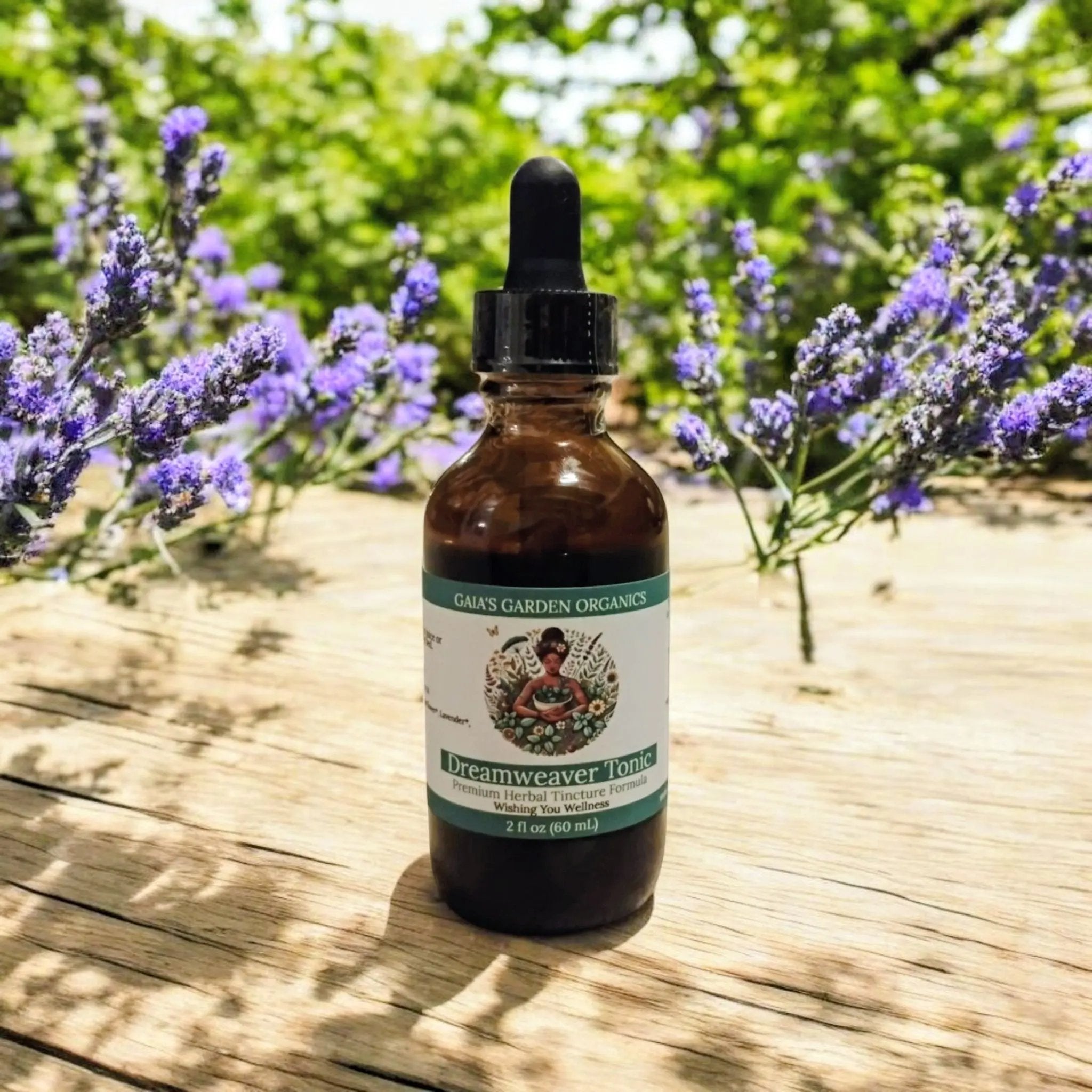
Dreamweaver Tonic is the herbal tincture I formulate specifically for this pattern. Two herbs, Skullcap and Lavender, both clinical-grade weight-to-volume extraction in organic alcohol, sourced from our medicine garden in Umpire, Arkansas. This guide covers what's actually happening when your mind won't quit, why these two herbs in particular, and how to use the tincture so it actually works.
What "racing mind" insomnia actually is
It is not melatonin deficiency. Your body knows it's bedtime. The lights are off. Cortisol is dropping. Melatonin is rising on its own schedule. The pineal gland is doing its job.
The problem is upstream. Your nervous system is still in sympathetic mode (the "on" branch) at 11pm, even though the body wants to shift to parasympathetic (the "off" branch). The mind takes its cue from the body. If the body is still active, the mind stays active. So the mind narrates. And narrates. And narrates.
This is why melatonin fails. Melatonin signals "it's bedtime" to a body that already knows what time it is. It does not unwind the nervous system. It pushes the body toward sleep while leaving the actual blocker in place.
Why two herbs, and which two
Dreamweaver Tonic is intentionally a two-herb formula. Most herbal sleep blends pile in five to ten ingredients, which dilutes the active dosing of each. We chose two herbs that each do one specific job and dose them properly.
Skullcap (Scutellaria lateriflora)
Skullcap is the herbal world's specific remedy for the bedtime mind that will not stop reviewing the day. Used in American eclectic herbal medicine for over two centuries for "nervous exhaustion with rumination," it is the herb a clinical herbalist reaches for when someone says "my body is tired but my brain won't shut up."
Mechanism: Skullcap is a nervine, a class of herbs that act directly on nervous-system tone. It calms without sedating. It does not knock you out. It quiets the looping commentary that keeps you awake while leaving you able to think clearly if you need to. A 2014 randomized controlled trial (Brock et al., on healthy volunteers) demonstrated measurable mood improvement with no side effects.
Lavender (Lavandula angustifolia)
Lavender does the body half of the work. Where Skullcap quiets the mental looping, Lavender unwinds the physical clench. It is a classic gentle sedative and a neuromuscular relaxant, traditionally used for the body that cannot settle into rest even when the bed is comfortable.
Mechanism: Lavender's linalool and linalyl acetate compounds reduce sympathetic nervous-system activation. The jaw unclenches. The shoulders drop. The chest opens. The body becomes the kind of body that can fall asleep.
Why the pair, not a longer list
Most herbal sleep blends include passionflower, valerian, hops, lemon balm, and chamomile alongside skullcap and lavender. Each is a fine herb. But cramming five into one ounce of tincture means each herb is sub-therapeutically dosed. You feel a vague pleasantness. You don't feel the actual mechanism.
Dreamweaver doses Skullcap and Lavender at clinical-strength weight-to-volume ratios calibrated for each herb. The mind quiets. The body softens. Sleep arrives because both blockers are addressed.
Why we don't include valerian
This is a question I get often. Valerian is a perfectly good sleep herb. We don't include it because it is sedating, and the racing-mind pattern is rarely a sedation problem.
Valerian also causes paradoxical agitation in roughly 10% of users (the body reacts opposite to expected). Skullcap doesn't do that. For the audience this formula is built for, Skullcap is the cleaner choice.
How to use Dreamweaver Tonic
- Standard dose: Two to three droppersful in a little water, 30 to 60 minutes before your intended bedtime.
- Timing matters more than dose: Taken at the bedside, the tincture acts as a sleep prolonger rather than a sleep inducer. Take it during the wind-down hour, not when your head hits the pillow.
- The ritual is part of the medicine: The act of pausing, measuring, sipping signals your nervous system that the day is closing. The herbs do the rest.
- What you'll notice: Within 20 to 40 minutes, racing thoughts soften. The jaw unclenches. The breath deepens on its own. Sleep arrives naturally rather than being forced.
- Daily, not occasional: The body learns the rhythm. Most clients take it every night for the first 30 days, then keep it nightly for the months after that. Non-habit-forming, no morning grogginess, no tolerance buildup.
What if it doesn't work the first night?
It might not. Sleep does not respond to a single dose the way a painkiller does. The tincture is most effective when it lands inside a daily rhythm.
If Night 1 is no different from a usual bad night, the most likely cause is timing (you took it too close to bed) or context (the bedroom is too warm, the phone is in the room, you had caffeine after noon). Our free 7-Night Sleep Reset protocol walks through each of those one night at a time. The tincture works much better inside the protocol than it does alone.
The deeper work: the sleep rhythm itself
The tincture supports the body. The protocol teaches the body. Both run together.
The 7-Night Sleep Reset is our free clinical-herbalist guide for the racing-mind sleep pattern. Seven nights, seven small shifts: the sleep window (fixed wake time), the caffeine audit, light hygiene (morning sun, evening dim), the wind-down hour, the bedroom audit, the 3-AM tool for the wake-ups that still happen, and integration. Most clients who pair Dreamweaver with the protocol sleep through the night by Night 4.
Where to go from here
- Step 1 (free): The 7-Night Sleep Reset PDF, a free clinical-herbalist guide. Get the protocol.
- Step 2 (30-night guarantee): Dreamweaver Tonic, two to three droppersful, 30 to 60 minutes before bed. Dreamweaver Tonic. If anxiety is the root pattern beneath the broken sleep, pair with Tranquility Essence as The 30-Day Calm Reset Kit (Dreamweaver + Tranquility + Healing Hypnotic Tea).
- Step 3 (coming soon): Harmony Within, my Yoga Nidra book. Thirty full guided scripts including dedicated sleep-onset and 3am-wake-up sessions.
This guide is for general sleep support and is not a substitute for medical care. If your sleep loss is tied to a clinical condition (sleep apnea, restless legs, severe insomnia, depression, or chronic pain), please work with a sleep specialist or physician.
Looking for the broader context on tinctures? Our pillar guide Herbal Tinctures 101 covers what tinctures are, how they're made, sublingual dosing, and how to choose between tinctures, teas, and flower essences.
Frequently asked
Will Dreamweaver Tonic work the first night?
Sometimes yes; often it takes 2-3 nights for the body to recognize the new rhythm. The tincture is most effective when it lands inside a daily wind-down ritual rather than as a single emergency dose. If Night 1 feels the same as a normal bad night, check timing (was it 30-60 minutes before bed, or right at bedtime?) and context (bedroom temperature, phone in the room, late-afternoon caffeine). The free 7-Night Sleep Reset walks through each of those one night at a time.
Is Dreamweaver habit-forming?
No. Skullcap and Lavender are both non-habit-forming, non-narcotic, and don't develop tolerance. You can take Dreamweaver nightly for years, or stop tomorrow with no withdrawal. Many of my clinic clients run on a nightly cadence for the first 30 days, then continue nightly as part of their wind-down ritual. Others take a 1-2 month course and then drop it once the sleep rhythm holds on its own.
How is this different from melatonin?
Melatonin tells the body it's bedtime, which is information the body already has at 11pm with the lights off. Melatonin doesn't address the upstream problem: a nervous system stuck in sympathetic activation. Dreamweaver works on the upstream problem directly. Skullcap quiets the racing mind; Lavender unwinds the physical clench. Sleep arrives because the body actually drops into parasympathetic state, not because a sleep-signaling hormone forces the issue.
Why don't you include valerian or passionflower?
Both are fine sleep herbs but they target slightly different patterns. Valerian causes paradoxical agitation in roughly 10% of users (the body reacts opposite to expected); Skullcap doesn't have that risk. Passionflower works well for anxiety-driven sleep loss but adds little to the racing-mind specific pattern beyond what Skullcap already does. Our philosophy is to dose two herbs at clinical strength rather than five herbs at sub-therapeutic strength. For the racing-mind audience, Skullcap + Lavender is the cleanest pair.
Can I take Dreamweaver with my prescribed sleep medication?
Generally yes, but please consult your physician first. Both Skullcap and Lavender are mild central-nervous-system relaxants, and stacking with prescription sleep medications (zolpidem, eszopiclone, doxepin, trazodone) can cause additive sedation. If you're tapering off a prescription sleep aid under medical supervision, Dreamweaver is often used as the bridge support. Never stop a psychiatric or sleep medication without your prescriber's guidance.
Products from this article
Handcrafted in Umpire, Arkansas by Gaia Devi, clinical herbalist.

Explore our apothecary
Learn more
Flower Essences 101
A clinical herbalist's plain-English guide to what flower essences are and how to take them.
Find your match
The Sleep-Type Quiz
5-question clinical-herbalist diagnostic that names your sleep archetype and matches an evening practice + plant pairing.
Shop the apothecary
Herbal Tinctures
Clinical weight-to-volume tinctures for nervous-system, sleep, and recovery work.
Sources & further reading
Authoritative references consulted in writing this article. Open in a new tab.
- PubMed (Brock et al., 2014)American Skullcap (Scutellaria lateriflora): a randomised, double-blind placebo-controlled crossover study of its effects on mood in healthy volunteers
- PubMed (Akhondzadeh et al., 2001)Passionflower in the treatment of generalized anxiety: a pilot double-blind randomized controlled trial with oxazepam
- PubMed (Amsterdam et al., 2009)A randomized, double-blind, placebo-controlled trial of oral Matricaria recutita (chamomile) extract therapy for generalized anxiety disorder
- PubMed (Chandrasekhar et al., 2012)A prospective, randomized double-blind, placebo-controlled study of safety and efficacy of a high-concentration full-spectrum extract of ashwagandha root in reducing stress and anxiety in adults
- NCCIHHerbs at a Glance (per-herb safety and evidence)