In this article (7)▾
Walk down any sleep-supplement aisle and valerian is on every other bottle. It is the most-studied sedative herb in the Western pharmacopoeia and reliably helps a portion of insomnia patients sleep. So why is our sleep tincture, Dreamweaver Tonic, intentionally valerian-free?
Because the audience our formula is built for, the racing-mind sleep-anxiety adult, is the audience valerian helps least and disturbs most. Here is the honest breakdown.
For the bigger picture on the format itself, see my guide to how a herbal sleep tincture works.
What's actually wrong with valerian
Nothing, for the people it works for. Valerian (Valeriana officinalis) has decent evidence for sleep-onset improvement. For about half the people who try it, it does what it says on the bottle. For the other half, three issues come up.
- Paradoxical agitation: Clinical estimates suggest 10 percent of valerian users experience the herb as activating rather than calming. The body reacts opposite to the expected effect: instead of sleep onset, you get restless, racing-thoughted, sometimes acutely anxious. This is more common in fast-metabolizing or naturally activated nervous systems, exactly the racing-mind sleep population our formula targets.
- Vivid dreams and night activation: Even when valerian helps you fall asleep, many users report intense, sometimes disturbing dreams and lighter sleep architecture. Some clients describe waking unrested despite eight hours.
- Morning grogginess and the smell: Valerian has a notoriously skunky smell (often described as "dirty socks") and produces morning grog in some users that lasts into mid-morning. Both make the daily ritual harder to keep up with.
Why Skullcap is the cleaner pick
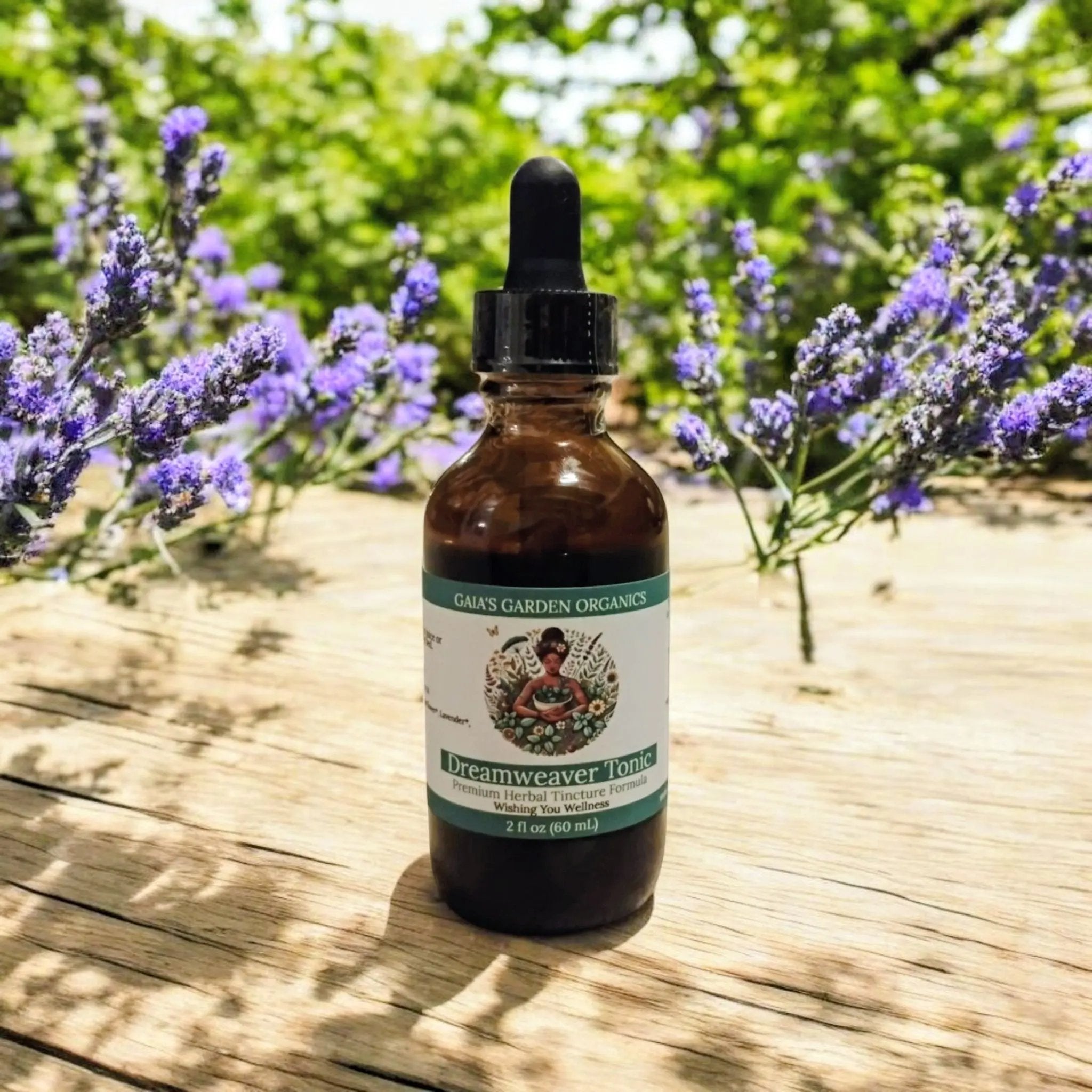
Dreamweaver Tonic combines three herbs: Skullcap (Scutellaria lateriflora), Passionflower (Passiflora incarnata), and Lavender (Lavandula angustifolia). Skullcap does the work valerian aims at, without the three downsides.
The 2014 Brock et al. randomized, double-blind, placebo-controlled crossover study on American Skullcap demonstrated measurable mood improvement in healthy volunteers with no side effects. Mechanism is nervine: skullcap acts directly on nervous-system tone, calming without sedating. It does not knock you out. It quiets the looping commentary that keeps you awake while leaving you able to think clearly if needed.
The paradoxical-agitation risk in skullcap is essentially absent. Sleep architecture under skullcap is closer to normal (deep, restorative sleep rather than the fragmented sleep some valerian users describe). And the smell is mild.
Why Passionflower
Skullcap quiets the looping commentary. Passionflower works on the adjacent layer: the racing-thought narration that happens when the body is tired but the mind keeps producing content. American eclectic herbalists called it "the thinking person's nervine" for this reason.
The 2001 Akhondzadeh et al. randomized, double-blind trial compared passionflower to oxazepam (a benzodiazepine) for generalized anxiety and found comparable anxiolytic effect with fewer side effects. People taking passionflower often describe the same anxious thought as "still there but without hooks." The thought passes through rather than camping for the night.
Why Lavender
Lavender unwinds the physical clench that pairs with the racing mind. Where skullcap and passionflower handle the cognitive layers, lavender handles the body: jaw drops, shoulders find their natural line, breath deepens. All three work in tandem.
Lavender's linalool and linalyl acetate compounds reduce sympathetic nervous-system activation. The body becomes the kind of body that can fall asleep.
Three herbs at clinical strength, not eight at sub-therapeutic strength
Most sleep blends cram five to ten herbs (valerian, hops, lemon balm, magnolia, chamomile, ashwagandha, hops, etc.) into one ounce of tincture. The result is each herb sub-therapeutically dosed. The blend tastes complex and feels gently warming but does not actually move the sleep needle.
Dreamweaver doses Skullcap, Passionflower, and Lavender at clinical-strength weight-to-volume extraction calibrated for each herb. Three herbs, each doing one specific job, properly dosed.
Who valerian-containing formulas still suit
People who have used valerian successfully without paradoxical agitation, who tolerate the smell, and who get the deep sleep they want. Several classic European formulas combine valerian with hops and skullcap and work well for this population.
If you have tried valerian and it worked, you may not need to switch. If you have tried it and got more wired instead of more asleep, this is your alternative.
Where to go from here
- Step 1 (free): The 7-Night Sleep Reset PDF, a clinical-herbalist guide that walks the evening ritual one night at a time. Get the protocol.
- Step 2 (30-night guarantee): Dreamweaver Tonic, two to three droppersful 60 minutes before bed. If anxiety is the root pattern beneath the broken sleep, pair with Tranquility Essence in The 30-Day Calm Reset Kit.
- Step 3 (coming soon): Harmony Within, my Yoga Nidra book.
This guide is general sleep-wellness education and is not a substitute for medical care.
Frequently asked
What's actually wrong with valerian?
Nothing, for the people it works for. Valerian (Valeriana officinalis) is one of the most-studied sedative herbs in the Western pharmacopoeia and reliably helps a portion of insomnia patients. The issue is that another portion (clinical estimates around 10 percent) experiences valerian as paradoxically stimulating rather than calming, and even those for whom it works often report vivid dreams, morning grogginess, and a notoriously skunky smell that can make a daily protocol hard to keep up with.
Does Dreamweaver have any morning grogginess?
For most clients, no. Skullcap, Passionflower, and Lavender all clear the body within a few hours of dosing, so a 60-minutes-before-bed dose has finished its primary work by the time you wake. A small subset of sensitive individuals report mild morning softness; in those cases reducing the dose from two droppersful to one usually resolves it. The herbs are also non-habit-forming and do not develop tolerance.
Will it work as well as valerian?
For the racing-mind sleep pattern that Dreamweaver is built for, generally yes or better. Valerian's strength is heavy sedation for people whose problem is being unable to physically settle. Skullcap + Passionflower + Lavender's strength is quieting the looping commentary, softening the racing-thought narration, and easing the physical clench, which is the racing-mind pattern's actual blocker. If your sleep issue is severe restlessness or deep nervous-system exhaustion without the looping-mind component, valerian-based formulas might suit you better.
Can I combine Dreamweaver with a valerian product I already have?
Generally yes at low doses, but check with your prescriber if you take prescription sedatives. All four herbs (valerian, skullcap, passionflower, lavender) are mild central-nervous-system relaxants, and stacking them can produce more sedation than you intend. If you are valerian-tolerant and want extra support, one dropperful of Dreamweaver alongside your usual valerian dose is a reasonable trial.
Is this safe with prescription sleep medication?
Please consult your prescriber. Skullcap, Passionflower, and Lavender are all mild CNS relaxants and stacking with prescription sleep medications (zolpidem, eszopiclone, doxepin, trazodone) or benzodiazepines can cause additive sedation. If you are tapering off a sleep prescription under medical supervision, Dreamweaver is often used as the bridge support. Never stop psychiatric or sleep medications without your prescriber's guidance.
Products from this article
Handcrafted in Umpire, Arkansas by Gaia Devi, clinical herbalist.
Explore our apothecary
Learn more
Flower Essences 101
A clinical herbalist's plain-English guide to what flower essences are and how to take them.
Find your match
The Sleep-Type Quiz
5-question clinical-herbalist diagnostic that names your sleep archetype and matches an evening practice + plant pairing.
Shop the apothecary
Herbal Tinctures
Clinical weight-to-volume tinctures for nervous-system, sleep, and recovery work.
Sources & further reading
Authoritative references consulted in writing this article. Open in a new tab.
- PubMed (Brock et al., 2014)American Skullcap (Scutellaria lateriflora): a randomised, double-blind placebo-controlled crossover study of its effects on mood in healthy volunteers
- PubMed (Akhondzadeh et al., 2001)Passionflower in the treatment of generalized anxiety: a pilot double-blind randomized controlled trial with oxazepam
- PubMed (Amsterdam et al., 2009)A randomized, double-blind, placebo-controlled trial of oral Matricaria recutita (chamomile) extract therapy for generalized anxiety disorder
- PubMed (Chandrasekhar et al., 2012)A prospective, randomized double-blind, placebo-controlled study of safety and efficacy of a high-concentration full-spectrum extract of ashwagandha root in reducing stress and anxiety in adults
- NCCIHHerbs at a Glance (per-herb safety and evidence)