In this article (10)▾
Most skincare focuses on what you put on the skin. Less attention goes to what supports the skin from inside: the gut function, the lymph drainage, the inflammatory baseline, the circulatory delivery of nutrients to the dermis. All of these are accessible through daily herbal tea.
This guide is the daily-tea framework I formulate for skin support and why these four herbs in particular work the systemic layer that topical products cannot reach.
If you want the foundation behind this daily cup, my guide to how herbal tea works for the skin explains it plainly.
What "tea for skin" actually does
Three mechanisms, none of them topical.
- Lymphatic and lymph drainage: The lymphatic system clears waste from tissue. Sluggish lymph drainage shows up as puffiness, dullness, and slow-healing breakouts.
- Anti-inflammatory baseline: Chronic low-grade inflammation is visible in skin as redness, irritation, and accelerated aging.
- Gut-skin axis: The gut and skin share inflammatory pathways; gut inflammation often shows up as skin symptoms (eczema, rosacea, breakouts).
The four-herb skin blend
Calendula (Calendula officinalis)
Calendula is the herb internally and topically used for skin. Internally, it is a lymphatic mover and gentle anti-inflammatory. The skin effect is indirect: when lymph is moving and inflammation is lower, skin clarity improves.
Spearmint (Mentha spicata)
Spearmint supports digestion and has mild anti-androgenic activity (the same effect that makes it useful for PCOS-related hirsutism). For hormonally-driven acne and excess oil, daily spearmint tea provides background support.
Hibiscus (Hibiscus sabdariffa)
Hibiscus brings a strong antioxidant load (vitamin C, flavonoids) that supports collagen synthesis and reduces oxidative damage. The fruit-acid content also supports gentle internal exfoliation through gut function.
Marshmallow Root (Althaea officinalis)
Marshmallow is a demulcent that coats and soothes the gut lining. Over weeks, it supports gut-wall integrity, which over months supports the gut-skin axis. The slow systemic work that compounds.
The daily ritual
- One mug daily, mid-morning or mid-afternoon. Caffeine-free, so it does not compete with your coffee.
- Two teaspoons of blend, hot water just off the boil, covered for 8-10 minutes.
- Pair with daily water hydration (skin needs water from inside too).
- Daily for 4-6 weeks before evaluating effects on the skin. The benefit is cumulative.
What to expect
- Week 1-2: Possibly nothing visible. The systemic work is starting.
- Week 3-4: Subtle improvements in skin clarity. Less reactive to typical triggers.
- Week 4-8: Friends and partners may comment that you look brighter. Inflammatory baseline has dropped enough to show.
- Month 2-3: The new baseline holds. Maintenance dosing (3-5 cups per week) sufficient to keep the effect.
What this is not for
- Acute acne flares from underlying medical conditions (severe cystic acne, hormonal disorders, dermatological diagnoses). The tea is supportive, not primary treatment.
- Skin cancers, melanomas, or any new or changing mole. See a dermatologist.
- Severe eczema, psoriasis, or autoimmune skin conditions. Tea can be an adjunct; primary care is dermatological.
Where to go from here
- Step 1 (free): Match your essence in 7 questions. Take the essence quiz.
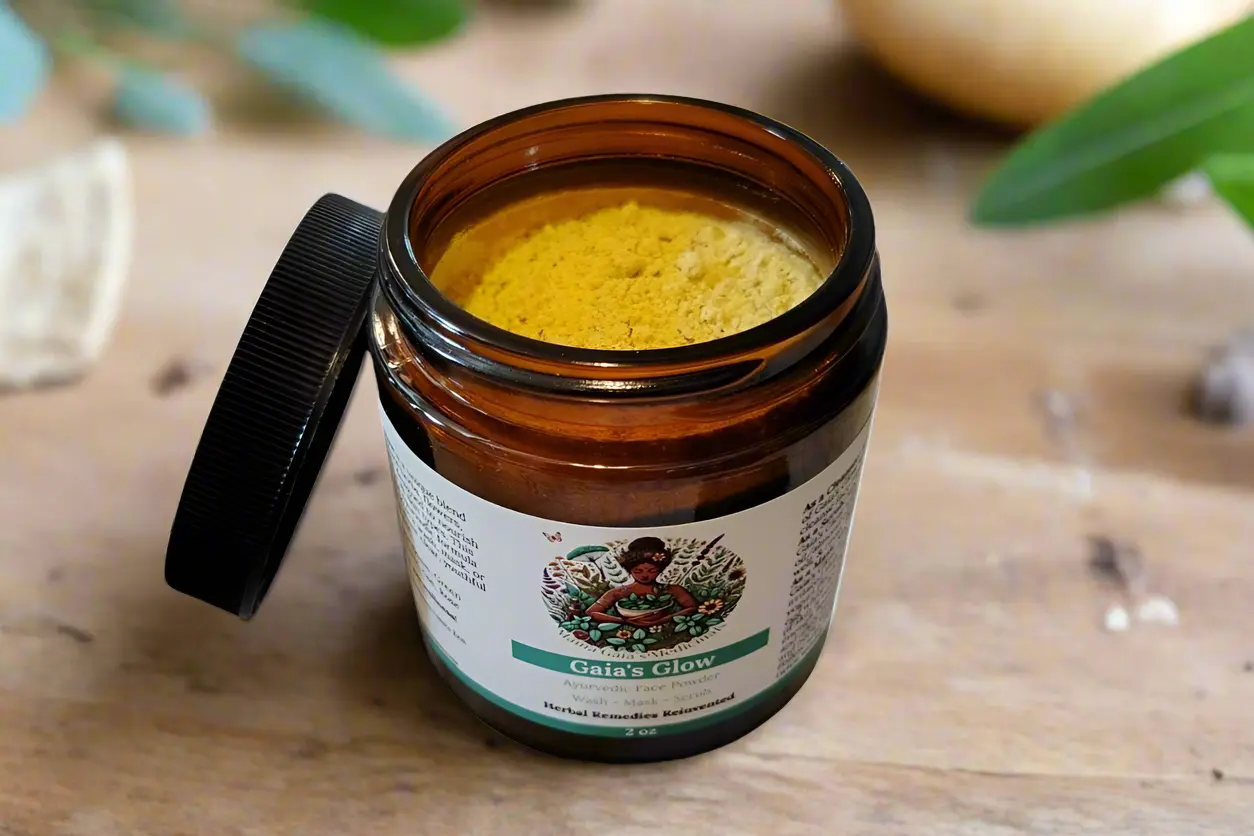
- Step 2 (30-night guarantee): Magical Marvel Herbal Tea contains calendula, spearmint, hibiscus, lemon balm, and marshmallow root, the skin-support framework as a daily cup. Pair with our Ayurvedic Face Powder for the topical layer.
- Step 3 (coming soon): Harmony Within, my Yoga Nidra book.
This guide is general skin-wellness education. Skin conditions that don't respond or worsen should be evaluated by a dermatologist.
Products from this article
Handcrafted in Umpire, Arkansas by Gaia Devi, clinical herbalist.
Explore our apothecary
Learn more
Flower Essences 101
A clinical herbalist's plain-English guide to what flower essences are and how to take them.
Find your match
Browse the Free Practice Library
8 pattern-matched archetype entry points (sleep, anxiety, tension, heart, inner quiet, clarity, boundary, spark), each as a 5-question quiz, a 3-day mini-course, or a one-tap interactive tool.
Shop the apothecary
Medicinal Herbal Teas
Loose-leaf, clinical-herbalist-blended teas, each built around a specific job.
Sources & further reading
Authoritative references consulted in writing this article. Open in a new tab.
- PubMed (meta-analysis, 2021)Efficacy of Hibiscus sabdariffa on Reducing Blood Pressure in Patients With Mild-to-Moderate Hypertension: A Systematic Review and Meta-Analysis of Published Randomized Controlled Trials
- NCCIHHerbs at a Glance (per-herb safety and evidence)
- Chestnut School of Herbal MedicineFlowering Herbs (article archive)
- Chestnut School of Herbal MedicineThe Best Home Herbal Apothecary Books