In this article (10)▾
The standard response to post-workout soreness is ibuprofen and a foam roller. Both have their place, but for the chronic tension pattern most stressed-out adults bring into their training, neither addresses the actual mechanism. The herbs that do are specifically nervines, not anti-inflammatories.
This guide is the natural-recovery framework I use in clinic for the tension-pattern athlete, the adult who trains hard, holds tension throughout the day, and ends up with soreness that ibuprofen masks but does not resolve.
The two soreness layers
- Genuine muscle fatigue: Microscopic muscle-fiber damage from training stress. Localized, dull, resolves in 48-72 hours through repair. Responds to ice, gentle stretching, sleep, and protein.
- Nervous-system bracing: Chronic tension the body adds on top of fatigue. Diffuse, day-after-day, includes jaw clench, shoulder hike, low-back holding. The pain is real; the cause is not tissue injury but a nervous system that has not learned to let go.
Knowing which layer your soreness is in determines what helps it.
The recovery herbs here are easiest to take as a tincture, and this guide covers how herbal tinctures fit into a daily routine.
The natural-recovery framework
1. Protein and hydration (the structural layer)
Within 30-60 minutes of finishing: a protein-containing snack (20-40 grams of protein) and hydration with electrolytes. This handles the genuine muscle fatigue layer. Boring but essential.
2. The downshift (the bracing prevention)
Five minutes of slow, intentional cooldown movement plus five minutes of stillness with slow breathing. Most adults skip this; this is where the bracing pattern locks in. Breathing 4 in, 6-8 out for 3-5 minutes activates parasympathetic tone and signals the body to come out of training state.
3. The tincture (the nervine layer)
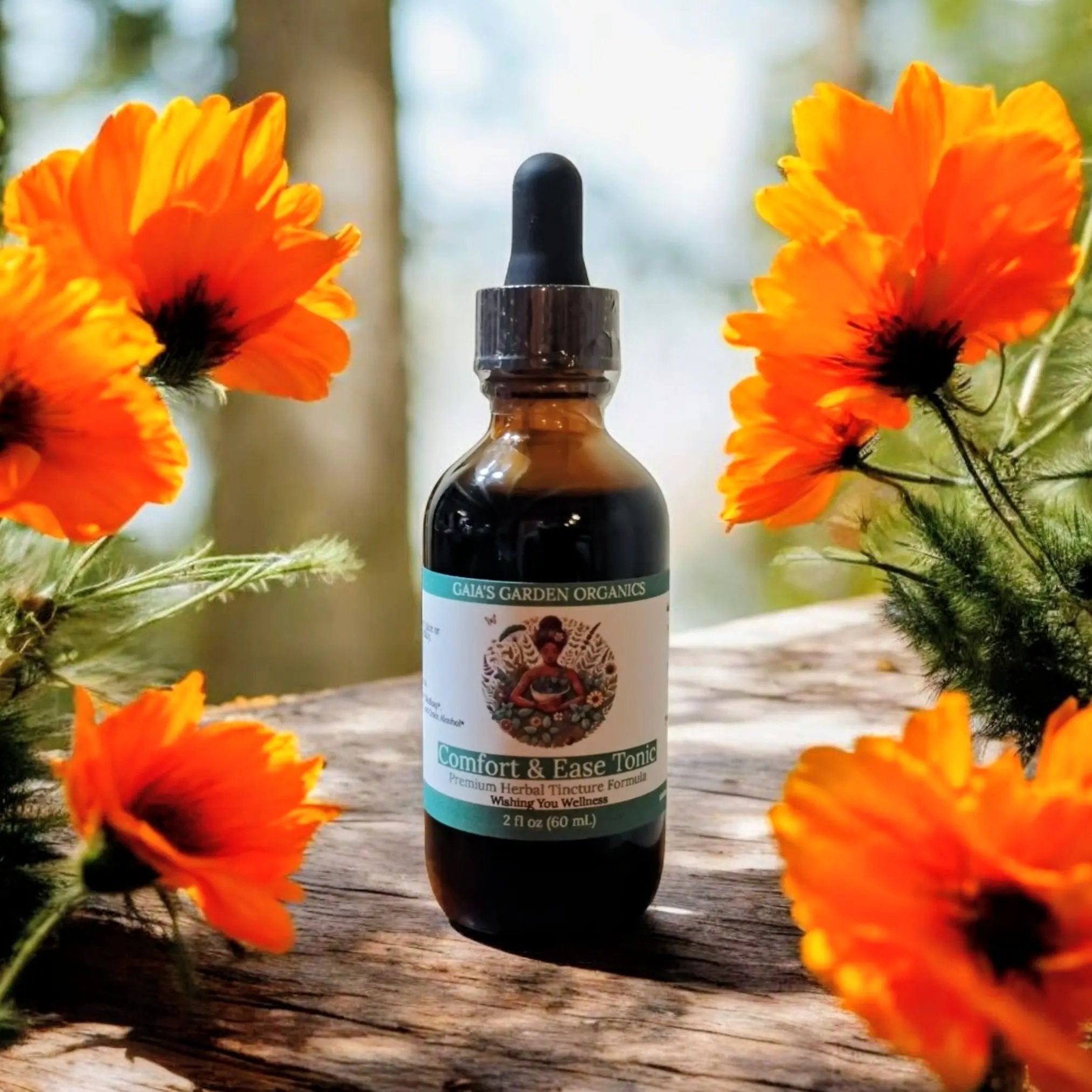
Comfort Ease Tonic (california poppy + passionflower + skullcap + blue vervain + rose), 1-2 droppersful within 30 minutes of finishing. The herbs work on the nervous-system signal that tells muscles to brace, not on inflammation. The result: the held places soften because the signal to hold them released.
4. Anti-inflammatory baseline (the long-arc layer)
Daily Magical Marvel Tea (calendula + spearmint + hibiscus + lemon balm + marshmallow root) reduces chronic systemic inflammation across weeks. Lower inflammatory drag means faster recovery, less cumulative fatigue, and better adaptation to training over months.
5. Sleep (the actual recovery)
Most muscle repair, hormone restoration, and nervous-system rebuild happens during sleep. For training-disrupted sleep, Dreamweaver Tonic 60 minutes before bed nightly during heavy training blocks. Protecting sleep is non-negotiable for athletic recovery.
What this is not for
- Acute sports injuries (sprains, strains, joint injuries). See a sports physician or physical therapist.
- Chronic pain syndromes or post-surgical recovery. Work with the appropriate clinician.
- Specific performance protocols at elite level. The framework is general daily recovery, not periodized programming.
The herbs that earn their place over ibuprofen
- California Poppy (Eschscholzia californica): Non-narcotic, non-habit-forming. Softens the held tension pattern by addressing the nervous-system signal. Will not show on drug tests.
- Skullcap (Scutellaria lateriflora): Classical American eclectic nervine. Removes the wired-up signal that keeps muscles bracing.
- Calendula (Calendula officinalis): Internal lymphatic mover and gentle anti-inflammatory. Daily-tea baseline.
- Hibiscus (Hibiscus sabdariffa): Antioxidant flavonoid load that reduces oxidative stress from training.
Ibuprofen has its place for acute injury pain and high-load competition. For chronic tension-pattern soreness from daily training, the herbal layer addresses the cause; ibuprofen only masks the signal.
Where to go from here
- Step 1 (free): The 7-Day Tension Release PDF. Get the protocol.
- Step 2 (30-night guarantee): Comfort Ease Tonic post-workout. Magical Marvel Tea daily for anti-inflammatory baseline. Dreamweaver Tonic for sleep protection during heavy training.
- Step 3 (coming soon): Harmony Within, my Yoga Nidra book.
This guide is general athletic-recovery support and is not a substitute for medical care.
Frequently asked
How does this compare to taking ibuprofen?
Different mechanisms. Ibuprofen blocks the inflammatory pain signal at the COX-1 and COX-2 enzyme level; effective for injury-pattern pain but with gut-lining and cardiovascular costs on chronic use. The herbal nervines address the upstream cause for the tension-pattern soreness most adults actually have. Many active clients use both: occasional ibuprofen for true acute injury or post-competition pain, herbal nervines daily for the chronic tension pattern. The herbs do not replace ibuprofen for acute injury.
Will the herbs slow my training adaptation?
No. Some research has suggested high-dose NSAIDs (ibuprofen) can mildly blunt muscle hypertrophy adaptation; the herbal nervines don't have this concern. They work on the nervous-system layer rather than the inflammation layer that drives adaptation. You can use Comfort Ease daily during training blocks without compromising the muscle-building signal.
When in the workout should I take the tincture?
Most clients take it within 30 minutes of finishing. The herbs land in 20-30 minutes and catch the bracing pattern as the body cools down. For high-tension training sessions where you tend to clench through the workout, you can also take 1 dropperful 30 minutes pre-workout; this often softens the in-session bracing.
Is this safe with my pre-workout, creatine, or protein supplement?
Yes. Comfort Ease has no documented interactions with common training supplements. The herbs work on different mechanisms than caffeine, beta-alanine, creatine, or protein. Some athletes find the post-workout tincture takes the edge off pre-workout stimulant carry-over.
How long until I notice the difference?
Acute effects from a single post-workout dose: 20-30 minutes (the jaw relaxes, shoulders drop, breath deepens). Cumulative effect on chronic tension pattern: 2-4 weeks of consistent daily use during training blocks. The long-arc shift (where the chronic bracing pattern softens enough to feel like a different body) builds across 2-3 months.
Products from this article
Handcrafted in Umpire, Arkansas by Gaia Devi, clinical herbalist.
Explore our apothecary
Learn more
Flower Essences 101
A clinical herbalist's plain-English guide to what flower essences are and how to take them.
Find your match
Browse the Free Practice Library
8 pattern-matched archetype entry points (sleep, anxiety, tension, heart, inner quiet, clarity, boundary, spark), each as a 5-question quiz, a 3-day mini-course, or a one-tap interactive tool.
Shop the apothecary
Shop the apothecary
Every flower essence, tincture, and tea on our shelves, clinical-grade plant medicine, seed-to-bottle.