Herb glossary · for the closed-heart phase of grief
Motherwort
Leonurus cardiaca
Family: Lamiaceae · Parts used: Aerial parts
Motherwort (Leonurus cardiaca) is the herb for the racing-heart kind of anxiety, a traditional cardiotonic and nervine in one, used across European and Chinese medicine for the chest-tight, palpitating, postpartum-tender, perimenopausal-overwhelmed nervous system.
Traditional uses
Motherwort (Leonurus cardiaca), Latin for "lion-hearted", is a tall, sharply-toothed mint-family perennial whose Latin name reflects its centuries-long reputation as a heart tonic, and whose common name reflects its use across the entire arc of mothering. It is one of the few herbs equally valued in European, Russian, and Chinese medicine, used in all three traditions for nearly identical purposes for over a thousand years.
Primary therapeutic territory
Motherwort is a cardio-nervine, meaning it works simultaneously on the heart muscle and the nervous system, with a particular affinity for the picture where they're both involved at once. Western clinical herbalism reaches for motherwort when anxiety comes with palpitations, when stress feels physically settled in the chest, when a postpartum or perimenopausal nervous system has become unusually tender, and when sleep is disturbed by a literal racing heart. The bitter taste, among the bitterest in common herbalism, also makes it gently digestive and liver-supportive.1,2
Other traditional uses
- Postpartum tenderness and "baby blues." One of the most traditional postpartum herbs across cultures, used during the first weeks after birth for the nervous, weepy, can't-quite-settle pattern. Often paired with rose.
- Perimenopausal anxiety with hot flashes and palpitations. The textbook herb for the perimenopause overlap of cardiovascular and nervous-system symptoms.
- Hyperthyroid-pattern anxiety. Some classical and modern sources note motherwort's traditional use for the anxiety-with-rapid-heart-rate-and-tremor pattern that overlaps with thyroid hyperactivity. Consult an endocrinologist for actual thyroid management.
- Premenstrual irritability with tension. The cycle-related anxiety that comes with chest tightness and short fuse.
- Menstrual cramps. Used traditionally for cramping with emotional reactivity, particularly when uterine cramping correlates with nervous-system spike.
How it appears in our garden
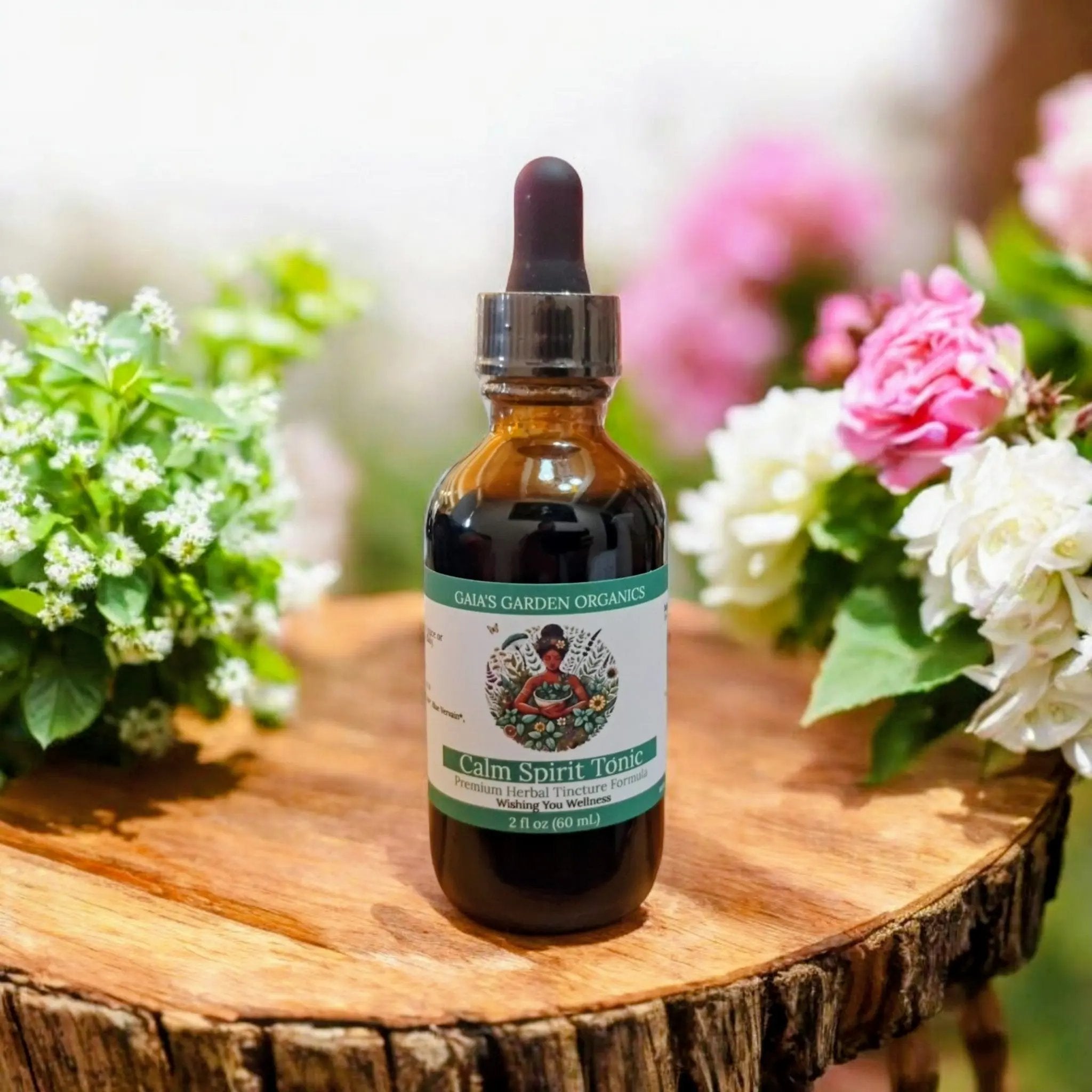
Motherwort is one of the more visually striking herbs in our Umpire garden, tall, sharply geometric, growing up the side of a stone wall in late spring. It anchors our Calm Spirit Tonic as the cardio-nervine layer beneath the gentler nervines, sitting alongside rose, tulsi, and blue vervain so the heart-and-nerve pattern is met on more than one level at once.
How we use motherwort at Gaia’s Garden
At Gaia's Garden Organics, motherwort (Leonurus cardiaca) grows in our medicine garden in Umpire, Arkansas. We harvest it ourselves, by hand, at the moment its medicine is at peak.
In our formulas
Gaia's Calm Spirit Tonic: Traditional heart-and-nerve tonic, used for a racing heart, chest-tightness, and the physical edge of anxious overwhelm.
Safety & considerations
Motherwort has a long traditional safety record but does have some specific contraindications worth flagging.
Pregnancy
Motherwort is contraindicated during most of pregnancy due to its uterine-stimulant action. It is sometimes used by midwives in late pregnancy and during labor under professional guidance, and is one of the most-used postpartum herbs once the baby is born. Do not use during pregnancy without midwife or obstetrician supervision.3
Heart medications
Because motherwort has measurable effects on heart rate and rhythm, it can interact with cardiac medications, particularly digoxin, beta-blockers, calcium channel blockers, and antiarrhythmics. The interaction is generally mild but may be additive. If you take any cardiac medication, consult your prescribing clinician before regular motherwort use.
Bleeding tendency and surgery
Motherwort may slow blood clotting in some individuals. Discontinue at least two weeks before planned surgery, and consult your physician if you take an anticoagulant such as warfarin, apixaban, or daily aspirin.
Bradycardia
People with naturally slow resting heart rates (under 60 bpm) should consult a clinician before using motherwort regularly, as the herb's mild rate-lowering effect could compound an already-slow rhythm.
Children and pets
Motherwort is not typically a pediatric herb. For pets, it has limited veterinary research; consult your veterinarian, especially for pets on cardiac or anti-anxiety medication.
Frequently asked
Why is it called motherwort?
Because it's been used across the entire arc of mothering, for menstrual cramps in adolescence, for trying-to-conceive anxiety, in late pregnancy and labor under professional guidance, and most prominently during the postpartum period for the tender, weepy, racing-heart pattern of new motherhood. The Latin Leonurus cardiaca means "lion-hearted" and points to the cardiovascular use.
Motherwort vs hawthorn for heart support?
Different fingerprints, often combined. Hawthorn is the long-haul cardiovascular tonic, used over months to support heart strength and circulation. Motherwort is more acute and nervous-system-leaning, for anxiety with palpitations, stress that lives in the chest, the racing-heart pattern.
Can I use motherwort during pregnancy?
Generally no, it's contraindicated during most of pregnancy due to uterine-stimulant action. Midwives sometimes use it in late pregnancy and during labor under professional guidance. Postpartum use, once the baby is born, is one of the most traditional applications. Always consult a midwife or obstetrician for any herbal use during pregnancy.
How does motherwort taste?
Famously bitter, among the bitterest of common Western herbs. The bitterness is part of why it works (bitter herbs reflexively stimulate digestion and liver function), but it's why most people take motherwort as a tincture rather than a tea, or combined with sweeter herbs in formulas.
Can I take motherwort with my heart medication?
Talk to your prescribing clinician first. Motherwort has measurable effects on heart rate and rhythm and can interact with digoxin, beta-blockers, calcium channel blockers, and antiarrhythmics. The interaction is usually mild but worth a conversation rather than a self-decision.
Is motherwort safe for pets?
Limited veterinary research. Holistic vets sometimes work with motherwort for anxious dogs with cardiovascular involvement, but the cardiac action means it's not appropriate for casual or unsupervised use. Consult your veterinarian, especially for pets on any cardiac or anti-anxiety medication.
References
- European Medicines Agency: Leonuri cardiacae herba assessment report
- Wojtyniak K et al. Leonurus cardiaca L. (motherwort): a review of its phytochemistry and pharmacology. Phytother Res. 2013;27(8):1115-20
- Memorial Sloan Kettering About Herbs: Motherwort
- American Botanical Council / HerbalGram
- Mountain Rose Herbs: Motherwort monograph