Herb glossary · for the 2 a.m. wide-awake adult
California Poppy
Eschscholzia californica
Family: Papaveraceae · Parts used: Aerial parts
California poppy (Eschscholzia californica) is a gentle, non-habit-forming nervine and mild analgesic, Western herbalism's answer to nervous-system overactivation that needs both physical settling and emotional softening.
Traditional uses
California poppy (Eschscholzia californica) is the bright orange wildflower of the American West and California's official state flower. Despite its appearance, it is not closely related to the opium poppy (Papaver somniferum) and contains none of the morphine, codeine, or other opioid alkaloids of that plant. The Indigenous peoples of California, including the Costanoan, Pomo, and Kashaya, used it long before European arrival, primarily for pain, sleep, and the kind of nervous-system intensity that needs gentling rather than sedating.1
Primary therapeutic territory
California poppy occupies a unique niche in Western clinical herbalism: a non-habit-forming herb that combines mild sedative, anxiolytic, and analgesic actions in one plant. It is the herb for the wired-and-tired-and-aching presentation, the chronic-stress picture where physical tension, mental restlessness, and lingering minor pain have all become part of the same pattern. Unlike pharmaceutical sleep medications and opioid pain relievers, California poppy does not produce dependence, withdrawal, or significant tolerance with regular use.2
Other traditional uses
- Sleep onset and maintenance. Particularly the sleep that's disturbed by both mental chatter and minor physical discomfort, the joint-aching, restless-leg, can't-find-the-comfortable-position pattern.
- Mild to moderate pain. Tension headaches, menstrual cramps, lingering musculoskeletal tightness. Often paired with skullcap.
- Pediatric anxiety and bedtime restlessness. One of the few stronger nervines that has a long traditional pediatric use; small doses for the wound-up, can't-settle child.
- Adjunct support during recovery from substance use. Used by some clinical herbalists as part of nervous-system rebuilding during taper from sedatives, alcohol, or opioids, always under medical supervision.
- Tooth and jaw pain. A traditional folk remedy, used as a tincture or compress for acute oral pain while waiting for dental care.
How it works
California poppy contains a different family of alkaloids from opium poppy, primarily protopine, californidine, and eschscholtzine, that appear to interact with GABA receptors and modulate other neurotransmitter pathways involved in sleep and mood. The mechanism is genuinely different from opioids; California poppy will not produce a positive opioid drug test.1,2
In our garden and formulas
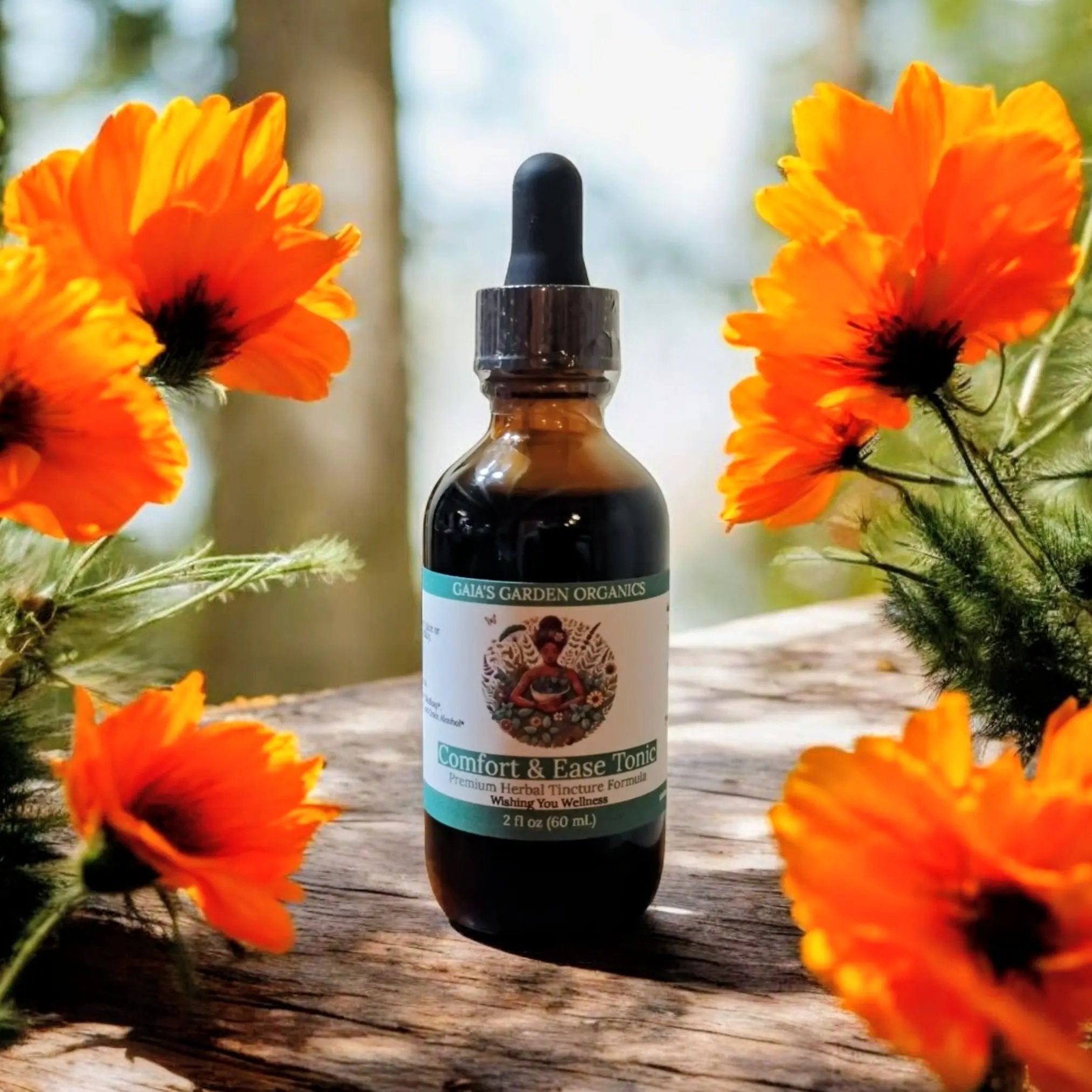
California poppy appears in our Comfort & Ease Tonic as the analgesic-nervine layer for everyday muscle tension, and in our Healing Hypnotic Herbal Tea as part of the bedtime nervine blend.
How we use california poppy at Gaia’s Garden
At Gaia's Garden Organics, california poppy (Eschscholzia californica) grows in our medicine garden in Umpire, Arkansas. We harvest it ourselves, by hand, at the moment its medicine is at peak.
In our formulas
Gaia's Comfort & Ease Tonic: Gentle pain-and-tension ally from the opium family, non-narcotic, non-habit-forming, traditionally used to ease held muscle tension and support restful sleep.
Safety & considerations
California poppy has a generally favorable safety profile and a long traditional record of safe use, including in pediatric and elder contexts. The cautions are about specific drug interactions.
Sedative interactions
California poppy may compound the effect of pharmaceutical sedatives, sleep medications, anti-anxiety drugs, opioid pain relievers, and alcohol. If you take any of these, consult your prescribing clinician before adding California poppy to a daily routine.
MAOIs
Some sources caution against combining California poppy with monoamine oxidase inhibitors due to theoretical interactions. If you take an MAOI antidepressant, discuss with your prescriber.
Pregnancy and lactation
Most modern herbal references recommend avoiding California poppy during pregnancy due to limited safety data and traditional uterine-stimulant reputation. Lactation use is less restricted but consult your midwife or obstetrician.
Driving and machinery
California poppy can produce mild drowsiness. Until you know how it affects you, avoid driving or operating heavy machinery within an hour of taking it.
Children and pets
Mild California poppy has traditional pediatric use under herbalist guidance for restlessness and minor pain. For pets, holistic veterinarians sometimes use California poppy for anxious dogs; consult your veterinarian, especially for pets on medication.
Frequently asked
Is California poppy related to opium poppy?
Different genus, different alkaloid family, no opioid content. California poppy is Eschscholzia californica; opium poppy is Papaver somniferum. California poppy contains protopine and californidine, sedative and analgesic, but not opioid. It will not produce a positive opioid drug test.
California poppy vs valerian for sleep?
Different fingerprints. Valerian is more strongly sedating but produces vivid dreams and morning grogginess for many users. California poppy is gentler, less prone to morning hangover, and uniquely useful when sleep is disturbed by both mental restlessness and minor physical pain. Many bedtime formulas combine California poppy with skullcap rather than valerian.
Is California poppy habit-forming?
No. Despite its mild sedative and analgesic actions, California poppy does not produce the dependence, tolerance, or withdrawal associated with pharmaceutical sleep medications or opioid pain relievers. This is one of the main reasons clinical herbalists favor it for ongoing pain and sleep support.
Can California poppy help with chronic pain?
For mild to moderate everyday pain, tension headaches, menstrual cramps, post-workout soreness, lingering musculoskeletal tightness, California poppy is a reasonable supportive herb. For severe, acute, or pathological pain, see a clinician; California poppy is gentle and is not a substitute for actual pain management.
Can I take California poppy with my anxiety medication?
Talk to your prescribing clinician first. California poppy may compound the effect of benzodiazepines, sleep medications, opioid pain relievers, and other pharmaceutical sedatives. The interaction is usually mild but additive, and worth a conversation rather than a self-decision.
Is California poppy safe for kids and pets?
For children, mild California poppy has traditional use under herbalist guidance for restlessness and minor pain, small doses, ideally under the supervision of a pediatric herbalist or clinician familiar with botanical medicine. For pets, holistic vets sometimes use it for anxious dogs; consult your veterinarian, especially for pets on medication.
Is California poppy good for sleep and pain?
Traditionally, yes, on both counts. California poppy is a non-habit-forming herb that combines mild sedative, anxiolytic, and analgesic actions in one plant, which is why it's reached for in the wired, tired, and aching pattern where mental restlessness and minor physical pain show up together. For sleep it can ease onset and maintenance, and for mild everyday pain like tension headaches, menstrual cramps, or post-workout soreness it's a reasonable supportive herb. For severe or persistent pain, see a clinician; it's gentle and not a substitute for actual pain management.
References
- Rolland A et al. Behavioural effects of the American traditional plant Eschscholzia californica. Planta Med. 1991;57(3):212-6
- Hanus M et al. Double-blind, randomised, placebo-controlled study of California poppy/hawthorn combination in mild-to-moderate anxiety. Curr Med Res Opin. 2004;20(1):63-71
- Memorial Sloan Kettering About Herbs: California Poppy
- American Botanical Council / HerbalGram
- Mountain Rose Herbs: California Poppy monograph