Herb glossary · for the racing-thought adult
Blue Vervain
Verbena hastata
Family: Verbenaceae · Parts used: Aerial parts
Blue vervain (Verbena hastata) is the herb for the chronically over-responsible nervous system, the perfectionist, the controller, the can't-let-go-of-the-shoulders pattern. A bitter nervine with a sharp, specific personality unlike any other in Western herbalism.
Traditional uses
Blue vervain (Verbena hastata) is the North American cousin of the European vervain (Verbena officinalis), both have nervine and bitter qualities, but the American species is taller, sharper-flavored, and more pointedly used by clinical herbalists for one specific personality of stress. It grows in moist meadows and ditches across most of the eastern half of North America, and was used by Iroquois and other Indigenous peoples long before European herbalism took notice.1
Primary therapeutic territory
Blue vervain has one of the most specific therapeutic personalities of any Western nervine. It is the herb for the chronic over-functioning nervous system: the person who can't stop running their to-do list at 3 a.m., who holds tension in the neck and shoulders as a constitutional baseline, who can't relax even when they finally sit down, who feels personally responsible for outcomes that aren't theirs to own. Where lavender or chamomile soften broadly, blue vervain reaches a particular pattern that other nervines can't quite touch, the type-A, perfectionist, hyper-vigilant constitution. Many clinical herbalists call this "the vervain pattern" and reach for it specifically rather than reflexively.2
Other traditional uses
- Tension that lives in the neck and trapezius. The "can't loosen the shoulders" pattern that's both physical and characterological, blue vervain works on both at once.
- Stress-driven hot flashes and night sweats. Particularly during perimenopause when emotional vigilance and hormonal change overlap.
- Bitter digestive support. Like most bitters, blue vervain reflexively stimulates digestion and liver function. Useful for the stress-skipped-lunch-now-can't-eat pattern.
- Mild fever support. Has a traditional diaphoretic reputation, though it's not the first choice for acute fever (yarrow and elderflower are).
- Headaches that come from clenching. Particularly tension headaches that arise from prolonged shoulder-and-jaw holding.
European vs American vervain
An important distinction. Verbena officinalis (European or "common" vervain) is the species in classical European herbalism, with overlapping but slightly different uses. Verbena hastata (blue vervain) is the North American species and the one we grow. Both are nervines and bitters; American blue vervain is generally stronger and more sharply targeted at the over-responsible nervous-system pattern. Reputable suppliers always specify which species.
In our garden and formulas
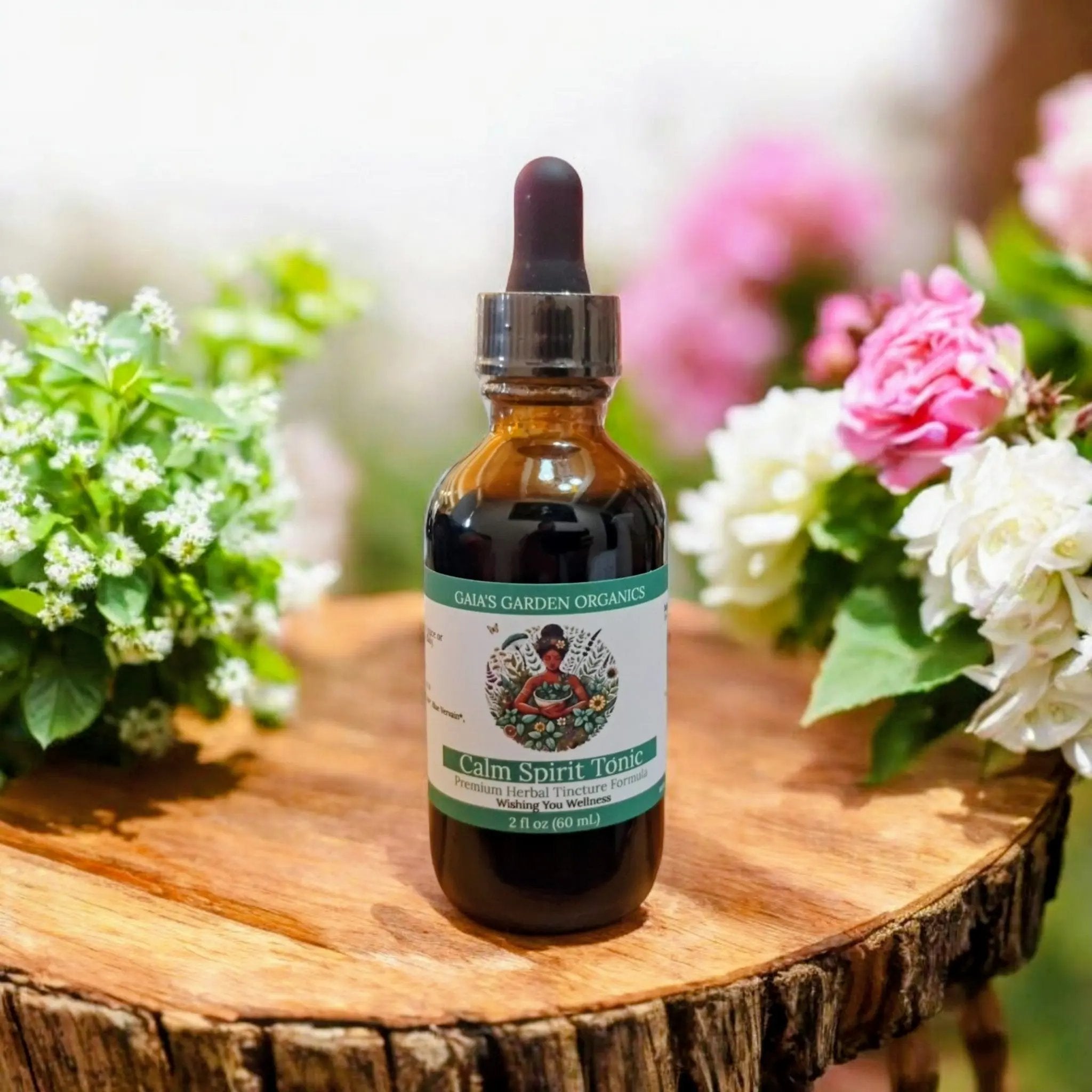
Blue vervain is one of the cornerstones of our Calm Spirit Tonic, there specifically to address the neck-and-shoulder, chronic-vigilance component of anxiety that purely mind-quieting nervines can't reach.
How we use blue vervain at Gaia’s Garden
At Gaia's Garden Organics, blue vervain (Verbena hastata) grows in our medicine garden in Umpire, Arkansas. We harvest it ourselves, by hand, at the moment its medicine is at peak.
In our formulas
Gaia's Calm Spirit Tonic: Traditionally used to release neck-and-shoulder tension held by the over-responsible, hypervigilant nervous system.
Safety & considerations
Blue vervain has a generally favorable safety profile but is one of the strongest-tasting and most physiologically active nervines, so a few cautions apply.
Pregnancy
Blue vervain has a traditional emmenagogue reputation and is generally avoided during pregnancy. It has been used by midwives in late pregnancy and during labor under professional guidance, but recreational or general-anxiety use during pregnancy is not advised. Postpartum use is more open. Consult your midwife or obstetrician.
Iron absorption
The bitter and tannin content of blue vervain may slow iron absorption when taken with iron-rich meals or supplements. Separate by an hour as a precaution if you're managing low iron.
Drug interactions
Limited documented drug interactions. Theoretical caution if combined with anticoagulants or antihypertensives due to mild blood-thinning and blood-pressure-lowering reputation; consult your prescriber if you take either category.
Vomiting at high doses
Blue vervain in large doses can produce nausea and vomiting, a feature of its bitter intensity rather than toxicity per se. Stick to recommended doses; a strong tea or a single dropperful of tincture is well-tolerated by most people.
Children and pets
Not a typical pediatric herb due to its bitter intensity and specific therapeutic personality. For pets, limited research; consult your veterinarian.
Frequently asked
Is blue vervain the same as European vervain?
Closely related but different species. European or "common" vervain is Verbena officinalis. Blue vervain is Verbena hastata, native to North America. Both are nervines and bitters with overlapping uses, but blue vervain is generally stronger and more pointedly targeted at the over-responsible, perfectionist nervous-system pattern. Reputable suppliers always specify which species.
How do I know if blue vervain is the right herb for me?
Blue vervain has one of the most specific personalities in Western herbalism. The classic indications are: chronic shoulder-and-neck tension you can't relax even at rest, can't-stop-running-the-to-do-list 3 a.m. wakefulness, perfectionist or controller temperament, taking on responsibility that isn't yours, tension headaches from clenching. If you read that and recognize yourself, blue vervain may be your match. If not, a broader nervine like lavender or chamomile may be a better fit.
How does blue vervain taste?
Sharply bitter, among the most intensely bitter herbs in common Western herbalism. Most people take it as a tincture rather than a tea, or combined with sweeter herbs in formulas. The bitterness is part of why it works (bitters reflexively stimulate digestion and liver) but it makes blue vervain an acquired taste.
Can I take blue vervain every day?
Most healthy adults tolerate daily blue vervain tincture indefinitely. Because of its specific therapeutic personality, blue vervain is more often used in courses (a few weeks at a time during particularly demanding stretches) than year-round. A clinical herbalist can help fine-tune duration.
Blue vervain vs skullcap, which one?
Different angles on tension. Skullcap is broader-spectrum, racing thoughts, jaw clenching, overall nervous-system buzz. Blue vervain is more specifically about chronic over-responsibility and the type-A constitutional pattern. Many calm formulas combine them; our Calm Spirit Tonic has both blue vervain and other nervines for layered support.
Is blue vervain safe for pets?
Limited veterinary research and a strong bitter intensity make blue vervain not a typical pet herb. Holistic veterinarians occasionally use related Verbena species; consult your veterinarian, especially for pets on medication.
References
- American Botanical Council, Verbena HerbalGram
- Wood M. The Earthwise Herbal: A Complete Guide to New World Medicinal Plants. North Atlantic Books, 2009
- Memorial Sloan Kettering About Herbs: Vervain
- Bone K, Mills S. Principles and Practice of Phytotherapy. 2nd ed. Churchill Livingstone, 2013
- Mountain Rose Herbs: Blue Vervain monograph