Herb glossary
Passionflower
Passiflora incarnata
Family: Passifloraceae · Parts used: Aerial parts (vine, leaf, and flower)
Passionflower (Passiflora incarnata) is the classic herbal ally for the racing-thoughts kind of anxiety and sleeplessness, a gentle, non-sedating nervine that quiets the busy mind without dulling the next morning.
Traditional uses
Passionflower (Passiflora incarnata) is a sprawling perennial vine native to the southeastern United States, with intricate purple-and-white flowers that early Spanish missionaries read as a depiction of the Crucifixion, hence the common name. Long before it appeared in European herbals, the plant was used by Cherokee and other indigenous peoples of the Americas as a calming sedative for the nervous system.
Primary therapeutic territory
Passionflower is the textbook herb for the kind of anxiety that runs as cycling thought rather than acute panic, the busy-mind insomnia, the can't-stop-reviewing-the-day pattern, the nervous tension that lives in the jaw and shoulders. Modern Western herbalism classifies it as a nervine (calms the nervous system) and a mild anxiolytic (eases anxiety). Several clinical reviews have explored its use for generalized anxiety, sleep onset, and pre-procedural nerves; while methodology varies, the cumulative evidence supports its long traditional reputation.1,2
Other traditional uses
- Sleep onset. Often combined with skullcap, chamomile, or California poppy in bedtime formulas, passionflower is for the mind that can't slow down at night, rather than for the body that won't rest.
- Nervous tension and muscle tightness. Holding tension in the neck, jaw, or shoulders that comes from chronic worry; passionflower's gentle muscle-relaxing reputation pairs with its mental-quieting action.
- Tapering nervous-system stimulants. Traditionally used during caffeine reduction or as a steadier in nicotine-cessation protocols.
- Premenstrual irritability. Where the cycle brings sharp mood swings and short-fused reactivity, passionflower has a long folk reputation as a softener.
- Restlessness in children. Western pediatric herbalism considers passionflower among the gentlest nervines, appropriate, in mild doses, for the bedtime-resistant or wound-up child (consult a pediatric herbalist or your child's clinician).
How it works
Phytochemical research on passionflower points to flavonoids (especially vitexin and isovitexin) and alkaloids that appear to interact with GABA receptors, the same neurotransmitter system that benzodiazepines act on, though far more gently and without the dependency profile.1 This is the proposed mechanism behind its mind-quieting effect.
How we use passionflower at Gaia’s Garden
At Gaia's Garden Organics, passionflower (Passiflora incarnata) grows in our medicine garden in Umpire, Arkansas. We harvest it ourselves, by hand, at the moment its medicine is at peak.
In our formulas
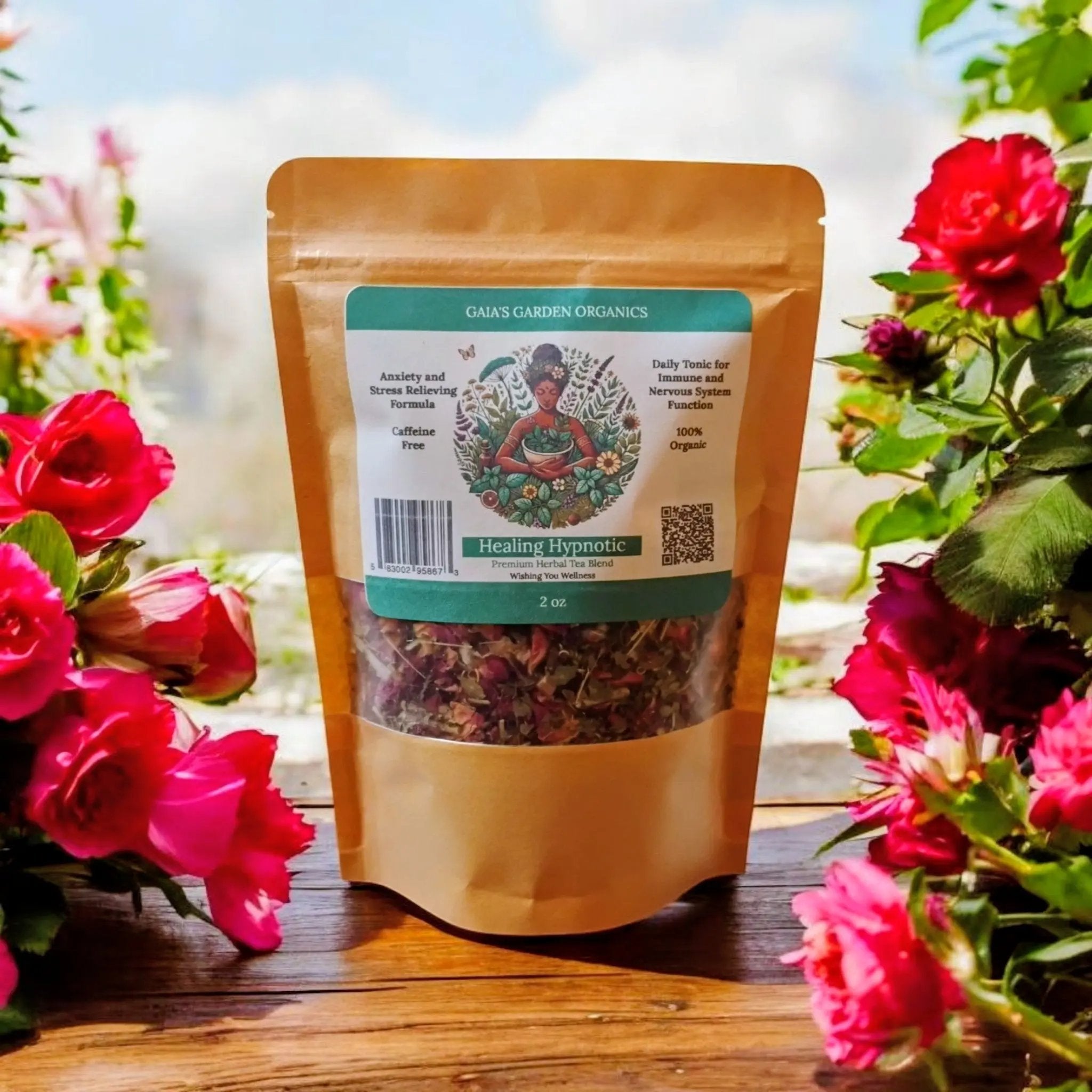
Gaia's Healing Hypnotic Herbal Tea: Classic sleep-and-nervous-system ally, traditionally used for the busy-mind kind of sleeplessness where thoughts won't stop reviewing the day.
Safety & considerations
Passionflower has a long traditional safety record and is generally well-tolerated by adults at standard doses. A few situations warrant caution.
Sedative interactions
Because passionflower interacts with GABA receptors, it may compound the effect of pharmaceutical sedatives (benzodiazepines like Xanax, Ativan, Valium), sleep medications (Ambien, Lunesta), or anti-anxiety drugs. If you take any of these, consult your prescribing clinician before adding passionflower.2
Pregnancy and lactation
Traditional use during pregnancy is contested. Some compounds in passionflower have shown uterine-stimulant effects in animal studies, leading most modern herbal references to recommend avoidance during pregnancy. Consult a midwife or obstetrician familiar with botanical medicine before use during pregnancy or breastfeeding.
Driving and machinery
Passionflower can cause mild drowsiness in some individuals, particularly at higher doses. Until you know how it affects you, avoid driving or operating heavy machinery within an hour of taking it.
Pets
Holistic veterinarians sometimes work with passionflower for anxious dogs and cats, but research is limited and dosing varies considerably by species and weight. We don't sell a pet-specific passionflower product. Consult your veterinarian, especially for pets on medication or with chronic illness.
Children
Passionflower has traditional pediatric use, but always at small doses and ideally under the guidance of a pediatric herbalist or a clinician familiar with botanical medicine.
Frequently asked
Is passionflower the same as the passion fruit plant?
Closely related but not identical. Passion fruit comes from Passiflora edulis. The medicinal species used in Western herbalism is Passiflora incarnata, sometimes called maypop, native to the southeastern United States. Both are in the Passiflora genus but have different therapeutic and culinary uses.
How long until I feel passionflower working?
For acute use (a panic moment, racing thoughts at bedtime), a tincture or strong tea typically lands within 20-45 minutes. For ongoing nervous-system support, effects deepen over 2-3 weeks of consistent daily use as the baseline anxiety setpoint shifts.
Does passionflower make you drowsy the next morning?
Generally no, that's part of why clinical herbalists favor it for sleep over heavier sedatives like valerian. Some sensitive individuals report mild morning grogginess at higher doses; if so, reduce the dose or take it earlier in the evening.
Passionflower vs valerian for sleep?
Different personalities. Valerian is more sedating and has a stronger immediate effect, but it produces vivid dreams and morning grogginess for many people, and ~10% find it actually stimulating. Passionflower is gentler, less prone to morning hangover, and more reliable for the racing-thoughts pattern of insomnia. Many bedtime formulas combine them.
Can I take passionflower with my anxiety medication?
Possibly, but talk to your prescribing clinician first. Because passionflower interacts with GABA receptors (the same system benzodiazepines act on), the combined effect can be additive. This isn't necessarily a problem, but it should be a conversation with your prescriber, not a self-decision.
Is passionflower safe for daily long-term use?
For most healthy adults, yes, it's been used as a daily nervous-system tonic for centuries. If you're using it nightly for sleep over many months, periodically check in with a healthcare provider to make sure underlying causes (sleep apnea, thyroid issues, chronic pain) aren't being masked.
References
- NCCIH, Passionflower
- Akhondzadeh S et al. Passionflower in the treatment of generalized anxiety: a pilot double-blind randomized controlled trial. J Clin Pharm Ther. 2001;26(5):363-7
- Memorial Sloan Kettering About Herbs: Passion Flower
- American Botanical Council / HerbalGram
- Mountain Rose Herbs: Passionflower monograph